How to Grow Tomatoes From Seed (Step-by-Step Guide)
- First time grower
- Indoor start
- Budget friendly
- Small space
I killed two full batches of tomato seedlings before I figured this out. The first time I overwatered them until they rotted. The second time I moved them outside too early and they fried in one afternoon.
Third time worked. Not because I found a better guide, but because I’d already made every mistake there was to make. This is the method I use now, step by step, with the specific numbers that actually matter.
Quick Answer
- Start seeds indoors 6-8 weeks before your last frost date
- Keep soil at 75-80F (24-27C) until sprouts appear (5-6 days at that temp)
- Seedlings need 14-16 hours of light per day. A windowsill probably isn’t enough.
- Harden off for a full 7-10 days before transplanting outside
- Best beginner pick: Celebrity. Determinate, disease resistant, hard to mess up.
What You’ll Need
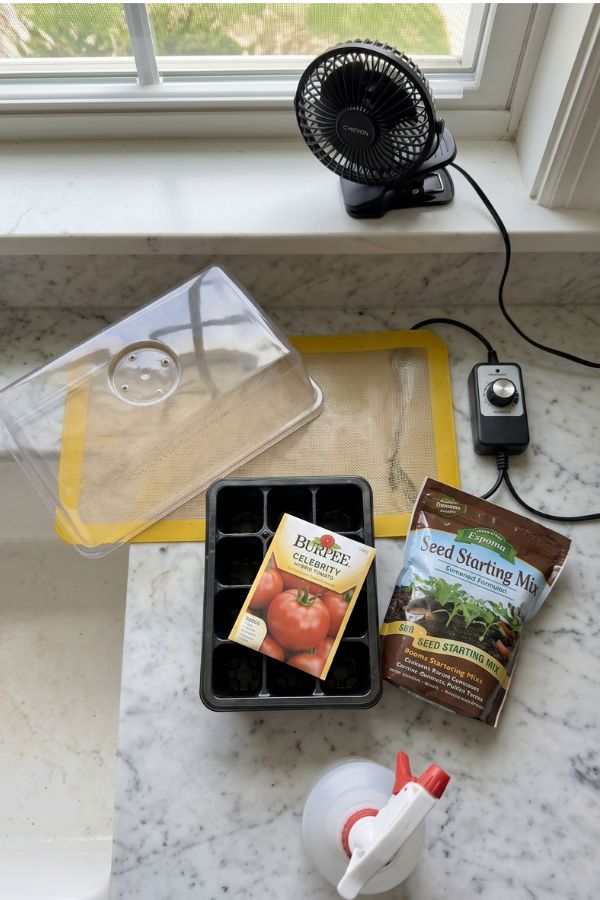
- Tomato seeds (Celebrity, Early Girl, or Sungold for beginners)
- Seed-starting mix (sterile, not potting soil, not garden soil)
- Small cell trays or pots
- Heat mat with thermostat (set to 75-80F)
- Grow light or very bright south-facing window
- Humidity dome or plastic wrap
- Spray bottle + shallow tray for bottom-watering
- Small clip-on fan
Time: 15 min setup + 6-8 weeks growing · Difficulty: Easy · Cost: Under $30 for a basic setup
Step 1: Pick your seeds
Start with a determinate cherry or slicer if this is your first time. Celebrity is the variety recommended by nearly every university extension office I’ve checked. It’s compact, disease resistant (VFNT), and produces reliably without needing a massive trellis.
Sungold and Sweet 100 are great cherry options if you want something faster and more forgiving. Early Girl matures in just 52 days if you have a short growing season.
Tip
Check the seed packet for disease resistance codes. V = Verticillium wilt, F = Fusarium wilt, N = Nematodes, T = Tobacco mosaic virus. More letters = fewer problems.
Step 2: Get your timing right
Count back 6 weeks from your last expected frost date. That’s when you start. Not 8 weeks. Not 10. Six.
Starting too early is the most common beginner mistake according to every source I’ve read. Seedlings started 10 weeks out become giant, rootbound, stressed plants by transplant time.
A stout 4-inch seedling outperforms a leggy 12-inch one every time.
Step 3: Plant the seeds
Fill your cell trays with seed-starting mix (not garden soil, not regular potting soil). Moisten the mix first. It should feel like a wrung-out sponge.
Drop 1-2 seeds per cell, about 1/4 inch (6 mm) deep. Press lightly for soil contact. Don’t bury them deeper or they’ll exhaust their energy before reaching the surface.
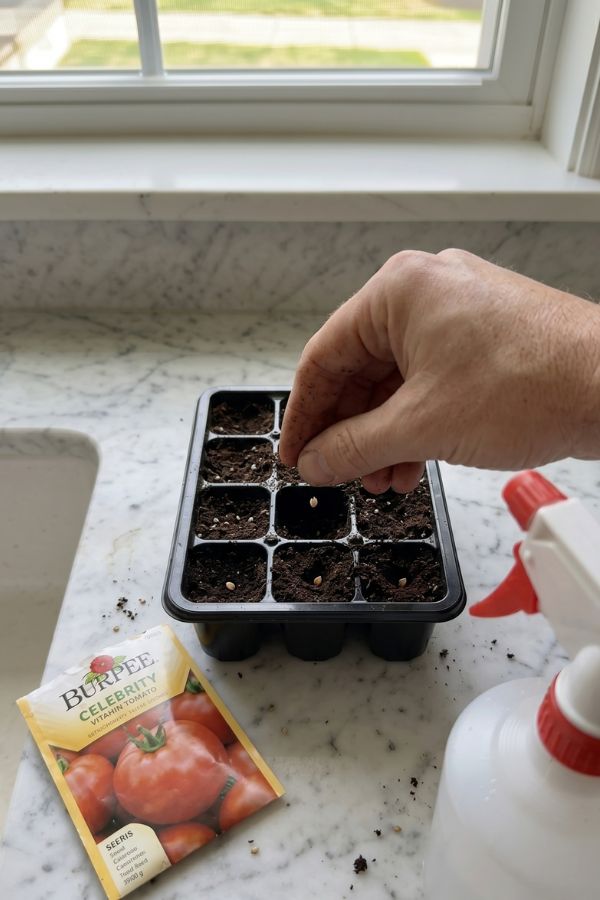
Mist the surface with a spray bottle. Cover with a humidity dome or plastic wrap. This traps moisture and creates a mini greenhouse.
Step 4: Heat is everything (this is where most people fail)
Tomato seeds need warmth to germinate, not light. Soil temperature of 75-80F (24-27C) is the sweet spot. At that temperature, according to Penn State Extension, seeds sprout in about 6 days.
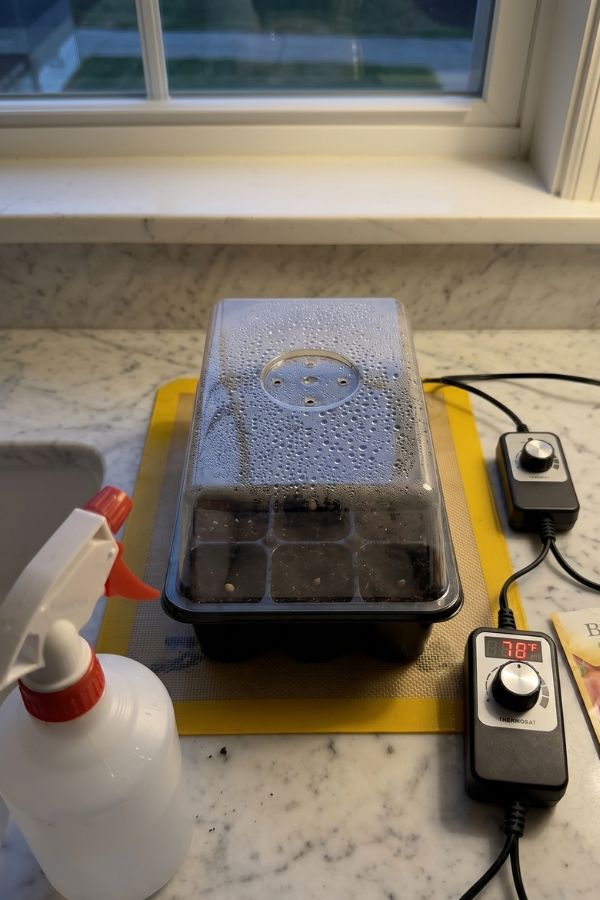
At 50F (10C)? It takes 43 days. Most windowsills in late winter sit around 55F. That’s why seeds “don’t work” for beginners. It’s not the seeds. It’s the temperature.
Common mistake
Putting seed trays on a cold windowsill “for the sun.” In February and March, windowsills are often the coldest spot in the house. The soil stays at 55F and nothing germinates. Use a heat mat. Warmth first, light after sprouting.
Put the trays on a heat mat set to 75-80F. Don’t put them on a sunny windowsill yet. They don’t need sun until they sprout. Check daily. Mist if the surface looks dry.
Step 5: Light and the windowsill truth
Once you see green, remove the humidity dome and the heat mat. Leaving the heat mat on after sprouting is one of the biggest “I wish I’d known” mistakes. It causes rapid, weak, leggy growth.
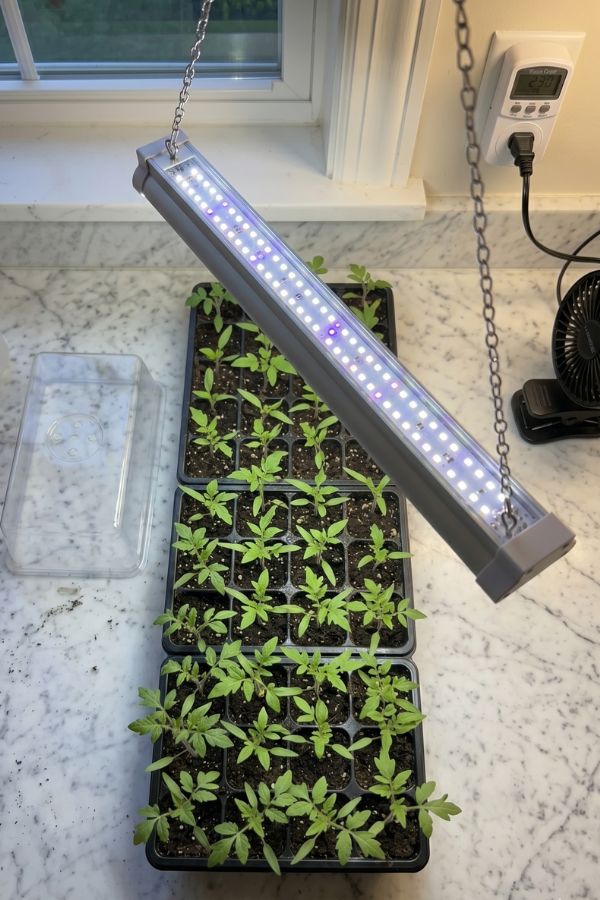
Now the seedlings need light. 14-16 hours per day. Here’s the honest part: a south-facing window probably isn’t enough (trust me, I tried). In late winter, the light angle is too low and the days are too short. Seedlings stretch toward the glass, grow tall and spindly, and fall over.
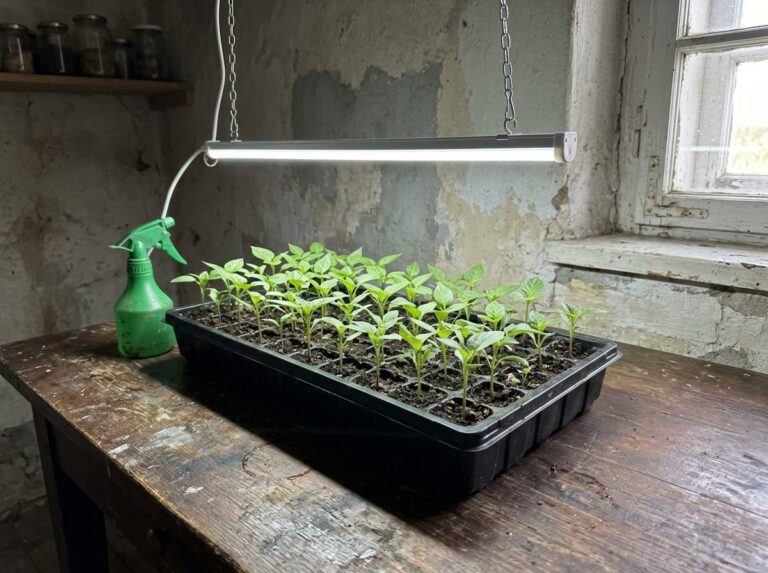
A basic LED shop light solves this. Hang it 2-3 inches (5-8 cm) above the seedlings. Put it on a timer for 15 hours. Basic T8 LED bars cost $15-20 and last for years. Best investment I’ve made for seed starting.
Did you know
Running a small fan on low near your seedlings makes the stems grow thicker. The movement triggers a stress response called thigmomorphogenesis that strengthens the plant. Even gently brushing the tops with your hand daily helps.
Step 6: Thin, pot up, and water correctly
When each cell has two seedlings, cut the weaker one at soil level with scissors. Don’t pull it. Pulling disturbs the roots of the one you’re keeping. Two seedlings in one cell just means two weak plants.
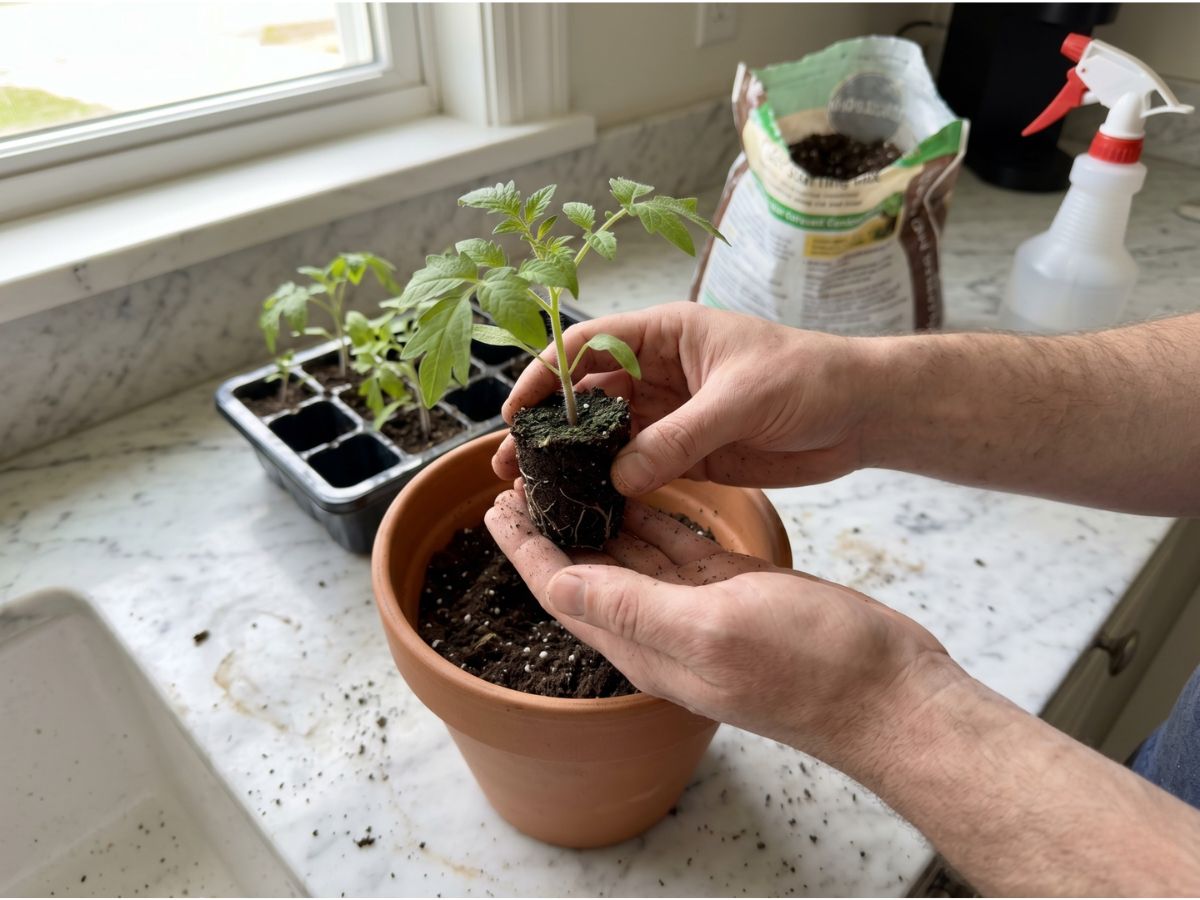
When the first set of true leaves appears (the jagged ones, not the smooth seed leaves), pot up to a larger container. Bury the stem up to the lowest leaves. Tomato stems grow roots along their entire buried length, which makes a stronger plant.
Switch to bottom-watering after germination. Place the tray in a shallow dish of water and let the soil wick moisture up from below. The surface stays drier, which drops your damping off risk significantly. Top-watering keeps the surface wet and that’s where the fungus lives.
Save this to PinterestStep 7: Harden off (don’t skip this)
This is where I lost my second batch. Went straight from indoor windowsill to full outdoor sun. They burned in one afternoon. Every single one.
Hardening off takes 7-10 days. Day 1-2: put them outside in full shade for 2 hours. Day 3-4: morning sun, afternoon shade, 4 hours. Day 5-7: gradually more sun, longer time. By day 10 they should handle a full day outside.
If temps drop below 50F (10C) at night, bring them back in. Tomatoes hate cold. According to WVU Extension, chilling injury starts below 55F (13C).
Step 8: Transplant
Transplant outside once nighttime temperatures stay above 50F (10C) and soil is at least 60F (15C). Bury the stem deep. Up to the lowest set of true leaves. This is one of the few plants where burying the stem actually helps.
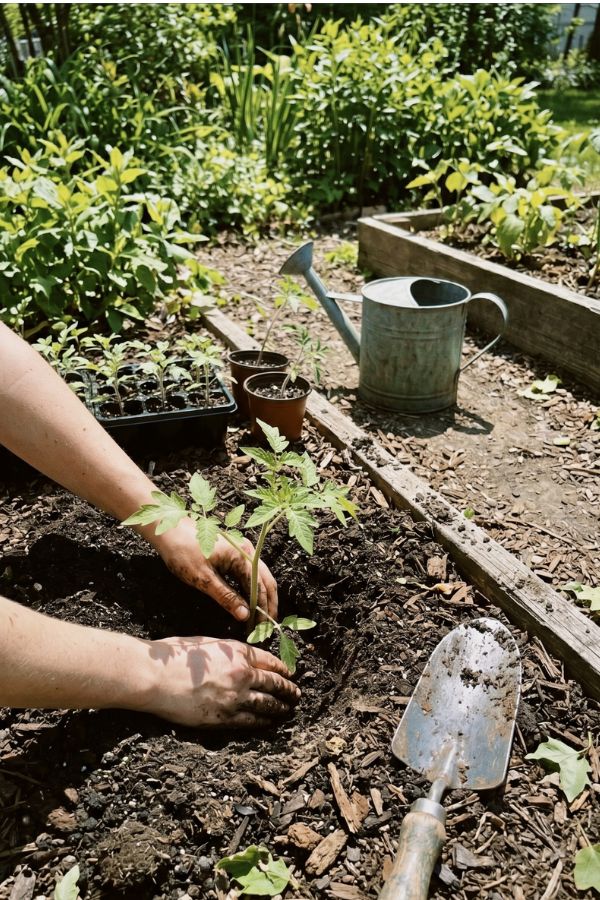
Space plants 18-24 inches (45-60 cm) apart if staking or caging. Water deeply at planting. Then leave them alone for a few days. They’ll look sad at first. They recover.
Mistakes I Made (So You Don’t Have To)
Every one of these cost me time, seedlings, or both.
- Overwatering seedlings. The soil should be moist, not shiny. If it’s shiny, it’s too wet.
- Starting 10 weeks early. Leggy, rootbound plants that never recovered properly.
- Leaving the heat mat on after sprouting. Caused fast, weak, floppy growth.
- Using a windowsill instead of a grow light. Two years of leggy seedlings before I gave in and bought a $20 LED bar.
- Skipping hardening off. Lost an entire tray in one afternoon of direct sun.
- Using garden soil in trays. Compacted, held too much water, and fungus killed half the batch (damping off).
- Watering with cold tap water. Caused purple undersides on the leaves. Thought it was a disease for an entire season. It was just cold water.
When Things Go Wrong
Seeds didn’t sprout after 2 weeks
Check the soil temperature. If it’s below 65F (18C), germination slows dramatically. At 50F it takes 43 days. Get a heat mat and try again with fresh seeds.
Seedlings are tall, thin, and leaning
Leggy seedlings. Not enough light. Move the grow light to 2-3 inches above the tops and run it for 15 hours. You can bury the leggy stem when potting up to recover some of the damage.
Seedlings fell over and died at the soil line
Damping off. A fungal disease caused by wet soil, poor air circulation, and cold temps. Switch to bottom-watering, run a fan, and use sterile seed-starting mix next time. There’s no saving a seedling once it’s collapsed.
Common Questions
Can I plant tomato seeds directly outside?
You can, but you’ll get fruit much later. Starting indoors gives a 6-8 week head start. In short-season climates, direct sowing often means frost hits before the tomatoes ripen.
Do I really need a grow light?
A very bright south-facing window can work in southern climates with long days. For everyone else, yes. A $20 LED shop light on a timer is the single best investment for starting seeds indoors. I resisted buying one for two years. Should have done it from the start.
How often do I water seedlings?
When the top of the soil is dry to the touch. Not on a schedule. Check daily, water when needed. More seedlings die from overwatering than underwatering.
Cherry tomatoes or full-size for a beginner?
Cherry. They’re more productive, more forgiving, and you get your first harvest faster. Graduate to heirloom beefsteaks once you’ve got a season under your belt (don’t ask how I know).
What does it cost to start tomatoes from seed?
Under $30 for a basic setup. Seed packet ($3-4), cell trays ($5), seed-starting mix ($6-8), LED shop light ($15-20). A heat mat adds another $15-20 but pays for itself in germination success. Compare that to $4-5 per transplant at the garden center and you break even after 8 plants.
Give It a Season
The first batch will probably have problems. Mine did. The second will be better. By the third you’ll wonder why you ever bought transplants from the garden center.
Start with Celebrity or Sungold, get a heat mat and a cheap grow light, and follow the soil temperature, not the calendar. Everything else is details.