How to Grow Zucchini Vertically (Without Snapping Vines)
- Small space
- Edible garden
- Vine training
- Beginner friendly
The first time I tried to grow zucchini vertically, I picked the wrong variety, used a tomato cage that buckled by July, and never figured out why most of my flowers dropped without setting fruit.
It was a slow, expensive failure.
Three things have to be right or vertical zucchini falls apart. The variety, the support, and what you do once the fruit starts to hang.
Here’s the version I wish someone had handed me two seasons ago.
The Short Version
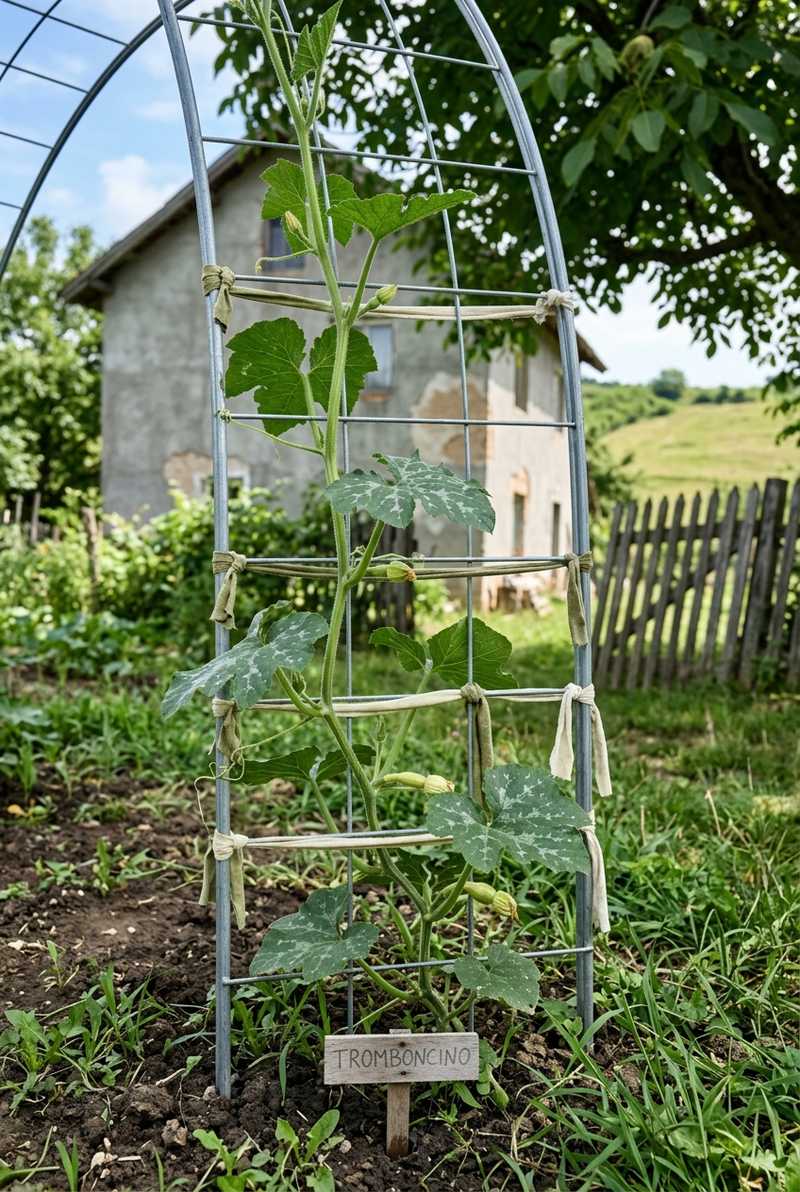
- Vining types only. Tromboncino, Costata Romanesco, or Black Forest. Bush types like Black Beauty can’t climb.
- Trellis at least 6 ft (1.8 m) tall, with posts 2 ft (60 cm) into the ground.
- Soft fabric ties every 6 to 8 inches (15 to 20 cm) as the vine grows.
- Sling any fruit that’s about to pass 1 lb (450 g). Tie the sling to the trellis, not the vine.
- Hand-pollinate before mid-morning. Most flowers close by lunchtime.
- If you only grow one vining squash this season, grow Tromboncino.
The Wrong Zucchini Will Never Climb
If you’re starting from a seed packet that says Black Beauty, Patio Star, or just “summer squash,” you’ve already lost.
Those are bush types. Their stems push out from a central crown and stay short and stocky. You can tie a bush zucchini to a trellis, but it will never climb one.
What you want is a true vining squash. Three are worth growing.
| Variety | Vertical reach | Notes |
|---|---|---|
| Tromboncino | 6 to 8 ft (1.8 to 2.4 m) | Natural climber. Vine-borer resistant. Eat young like zucchini or let mature into winter squash. |
| Costata Romanesco | 4 to 5 ft (1.2 to 1.5 m) | Italian heirloom. Ridged fruit, nuttier flavor, holds up to grilling. |
| Black Forest | 4 to 5 ft (1.2 to 1.5 m) | Bred specifically for trellis growing. Classic zucchini taste. |
A note on Tromboncino. It’s actually a different species from standard zucchini (Cucurbita moschata, not C. pepo), and that’s the whole point.
Its stems are solid, not hollow. Squash vine borers can’t colonize solid stems. That’s why mine kept producing into September the year my standard zucchini patch collapsed by mid-July.
If you already bought Black Beauty seeds, don’t throw them out. Plant them and let them sprawl on the ground like nature intended. Just don’t expect a vertical garden out of them this year.
What You’ll Need
- Vining zucchini seeds or seedlings (Tromboncino, Costata Romanesco, or Black Forest)
- A support at least 6 ft (1.8 m) tall. Cattle panel arch, A-frame, or deep-anchored flat trellis all work.
- Soft fabric ties (cotton strips from an old t-shirt, garden velcro, or stretchy plant tape)
- Sling material (pantyhose, mesh produce bags, or t-shirt strips cut to 12 inches / 30 cm)
- A small artist’s brush or cotton swab for hand pollination
- A long-spout watering can or drip line (no overhead watering)
Time: 20 minutes to set up, then about 15 minutes a week once vines are climbing · Difficulty: Easy, once you stop fighting the plant
Build a Support That Holds 30 Pounds
A single Tromboncino vine can produce 20 to 40 fruits across a season, and each one can hit 2 to 3 lbs (1 to 1.4 kg). The math gets ugly fast.
Most flat trellises don’t fail because of the vine. They fail because they aren’t anchored deep enough. The plant is fine. The structure tips over.
Three supports actually work for full-season vertical zucchini.
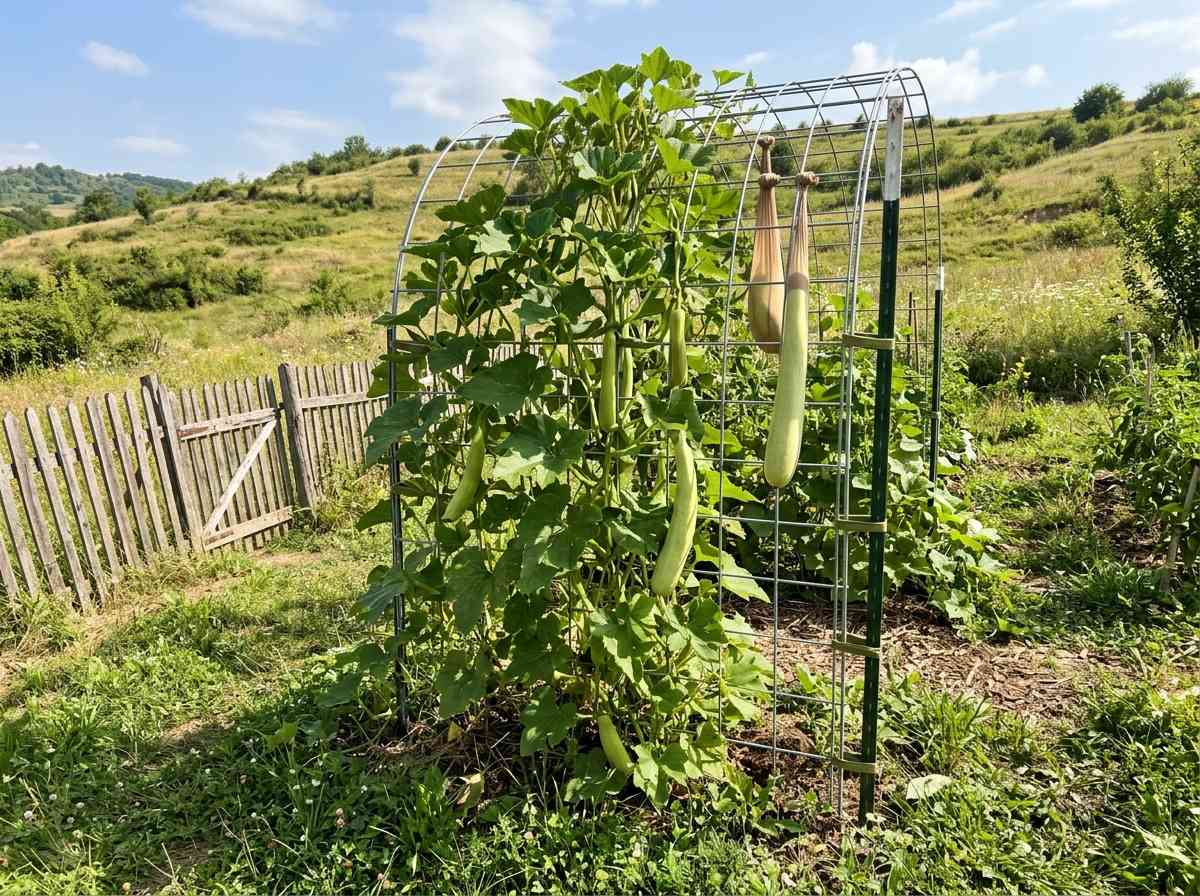
- Cattle panel arch. A 16 ft (4.8 m) galvanized cattle panel bent into an arch between two raised beds. Around $25 at a farm store. Outlives the garden. Harvest is awkward because fruit hangs on both sides, but the strength is unmatched.
- A-frame trellis. Two 6 ft (1.8 m) 2x2s leaned together at the top, with deer netting or hog panel stretched between. Most stable in wind. Around $25 to $40 in materials.
- Flat trellis with deep posts. Works only if the posts go at least 2 ft (60 cm) into the ground. Shallower than that and it tips by August.
Skip the bamboo teepee. I tried one and it folded under fruit load by week seven.
The University of Minnesota Extension recommends keeping trellised fruit under 3 lbs (1.4 kg) before adding extra support. Anything heavier and you have to take some weight off the structure yourself. More on that in a minute.
Tie It Like a Hollow Stem (Because It Is)
Zucchini stems are hollow. They look thick and tough, but inside they’re basically a straw.
The first time I used plastic tomato clips, two of them sliced clean through the vine within a week. Not a tear. A clean cut.
That’s from a Houzz gardening forum, and it matches exactly what I learned the hard way. Zucchini doesn’t have tendrils. It won’t grab anything on its own.
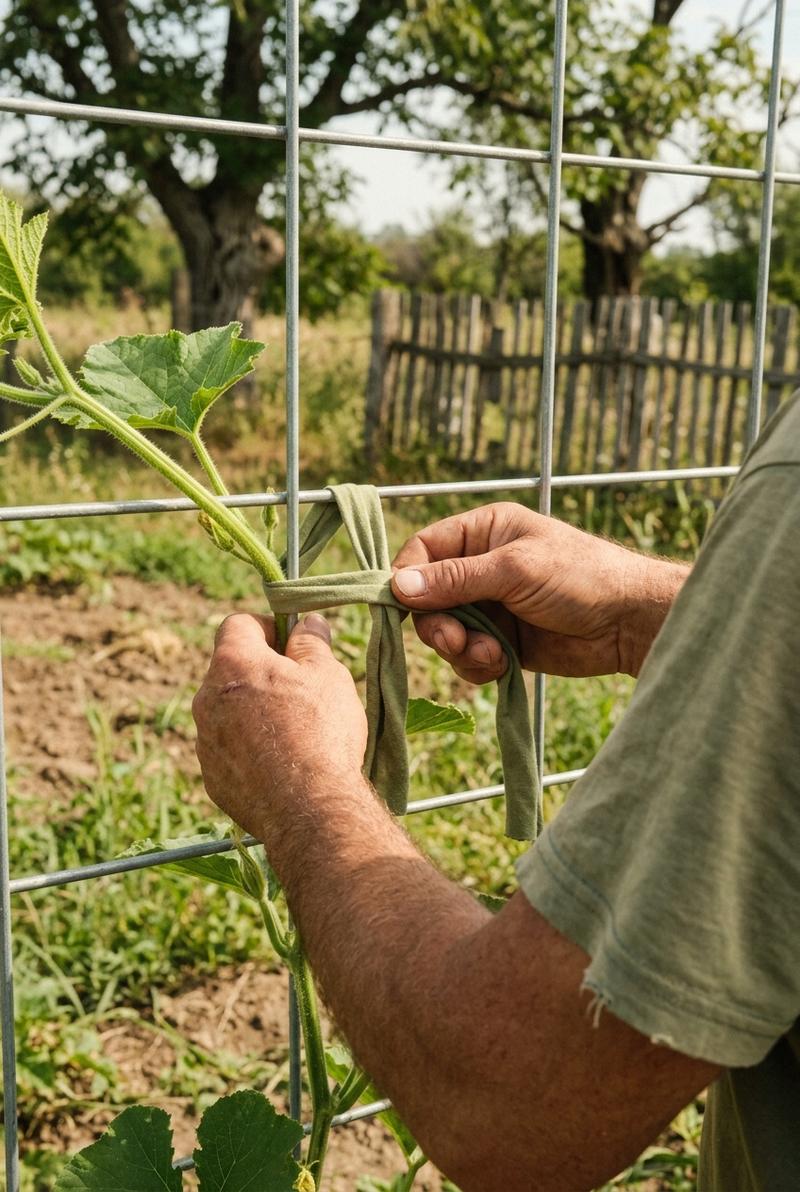
You have to physically lift the main stem and tie it in place. Start at the seedling stage. Once the plant is 6 inches (15 cm) tall, loop a soft strip of fabric around the stem and the trellis. Add another tie every 6 to 8 inches (15 to 20 cm) as the vine grows up.
The material matters more than people think.
- Works: soft cotton strips cut from an old t-shirt, garden velcro tape, stretchy green plant ties
- Doesn’t work: plastic tomato clips, twist ties, anything that has to be tight to hold
Common mistake
Trying to retrofit a mature plant. If you let the vine sprawl for six weeks and then try to bend it up to a trellis, the stem snaps at the base. Start training the day you plant out, not the day you finally get around to it.
Slings, the Step Almost Nobody Mentions
This is the part competitor articles skip, and it’s the reason most vertical zucchini setups fail in August.
Once your fruit hits about 1 lb (450 g), it’s heavy enough to bend the vine at the point where the fruit attaches. The vine doesn’t always snap.
Sometimes it just kinks, and from then on the fruit develops weirdly or rot sets in at the bend. Either way, you lose the fruit.
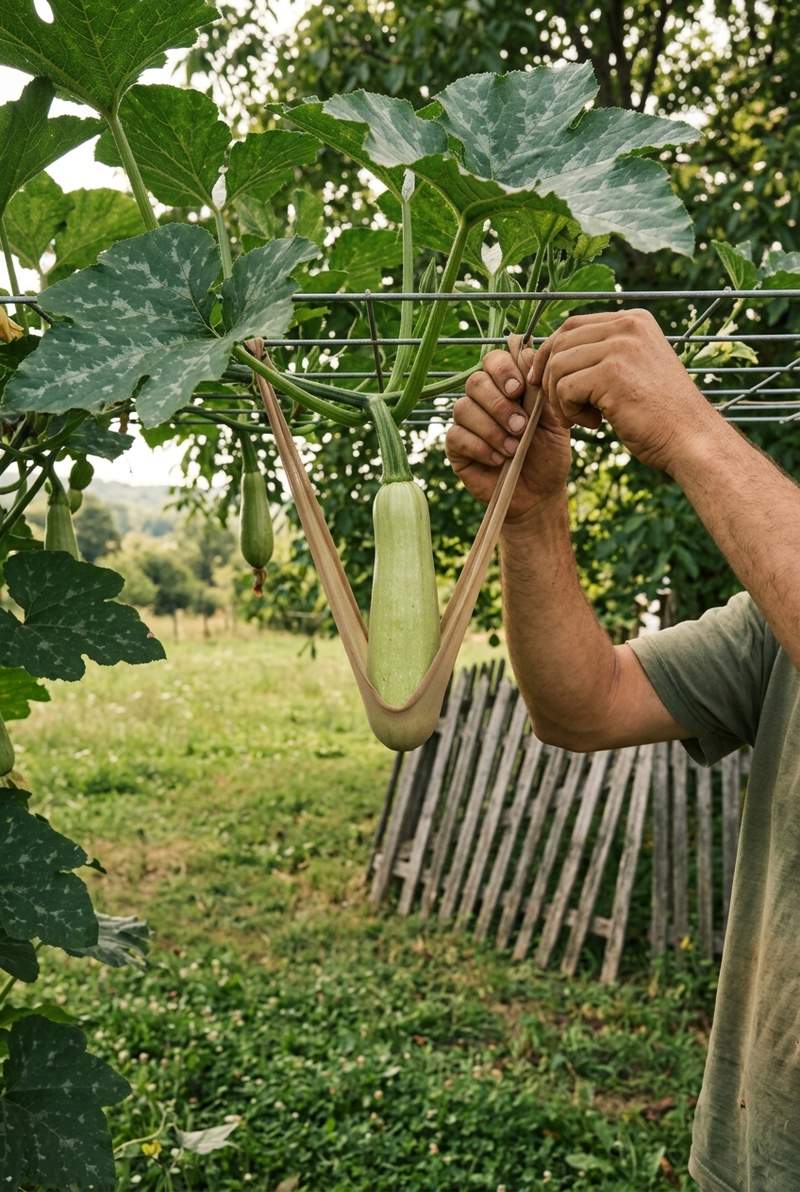
The fix is a sling that takes the weight off the stem. It takes about two minutes to make.
- Cut a 12 inch (30 cm) length of pantyhose, mesh produce bag, or stretchy t-shirt strip
- Slide the developing fruit through the loop, like a hammock
- Tie both ends to a strong horizontal point on the trellis frame
- Never tie the sling to the vine itself. That just moves the problem one knot down.
Install slings before the fruit needs them. Once a zucchini is 6 to 8 inches long (15 to 20 cm) and as thick as your thumb, it’s already adding ounces fast. Sling it then, not after.
(I lost three good fruits in one weekend learning this, so trust me on this one.)
Save this to PinterestWhy Your Flowers Open Once and Close by Noon
Vertical zucchini doesn’t fail because of light, soil, or water. It fails because of pollination, and most people never figure out it was the pollination.
Each female flower opens for one morning. By early afternoon, it’s closed and that’s its only shot.
Vertical growing makes the problem worse. When fruit and flowers are 4 to 6 ft (1.2 to 1.8 m) off the ground, bees miss them more often than ground-level squash. If your vines look healthy but most baby fruits yellow and drop a few days after forming, this is almost always why.
Did you know
Squash pollen loses more than 95% of its viability within 24 hours, and rainwater destroys what’s left almost instantly. If it rained overnight, wait two hours after sunrise for the flower to dry, then pollinate.
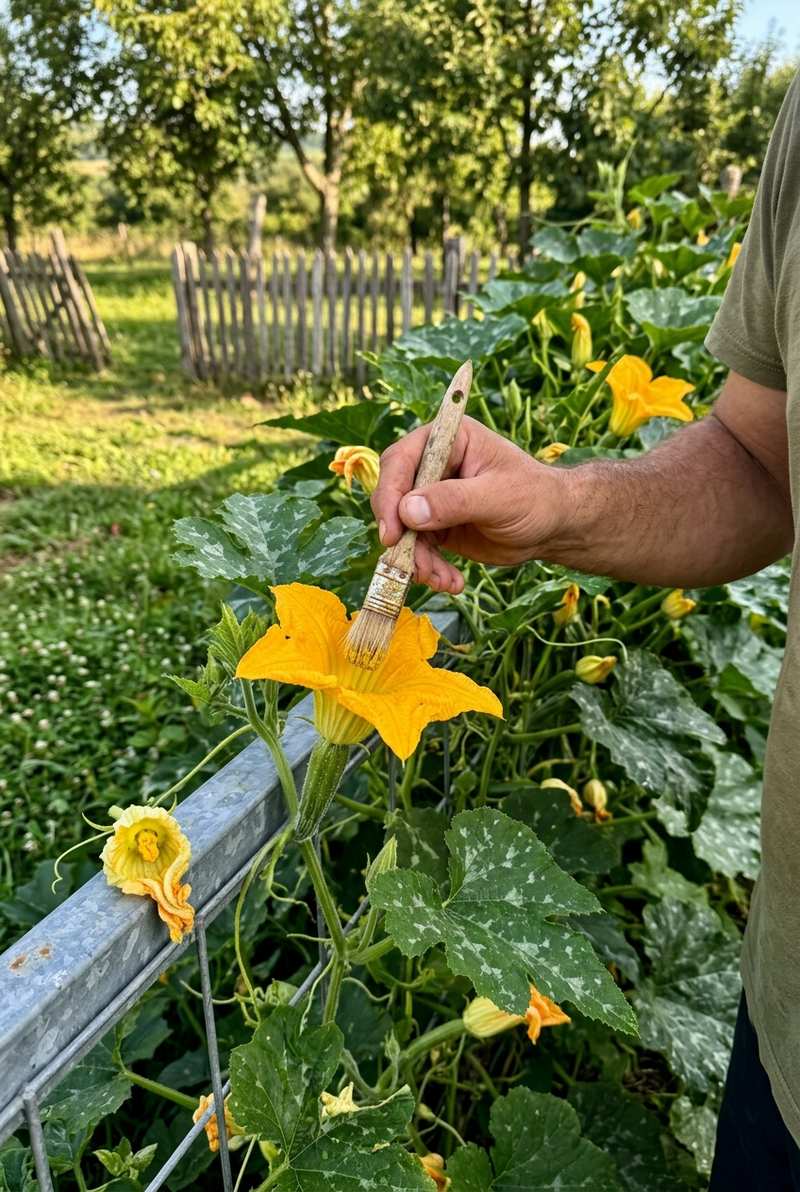
The fix is hand pollination, and it takes about 90 seconds per flower.
- Look for an open male flower (straight stem, no swollen base) early in the morning
- Snap it off, peel back the petals, and gently rub the pollen-covered center against the inside of any open female flower (the one with a tiny zucchini-shaped swelling at the base)
- One male can pollinate two or three females
- Do this before 10 a.m. Most flowers are closed by lunch.
If you don’t want to sacrifice the male flower, a small artist’s brush or cotton swab works almost as well. Dip, transfer, done.
Keep Mildew Off a Tightly Packed Plant
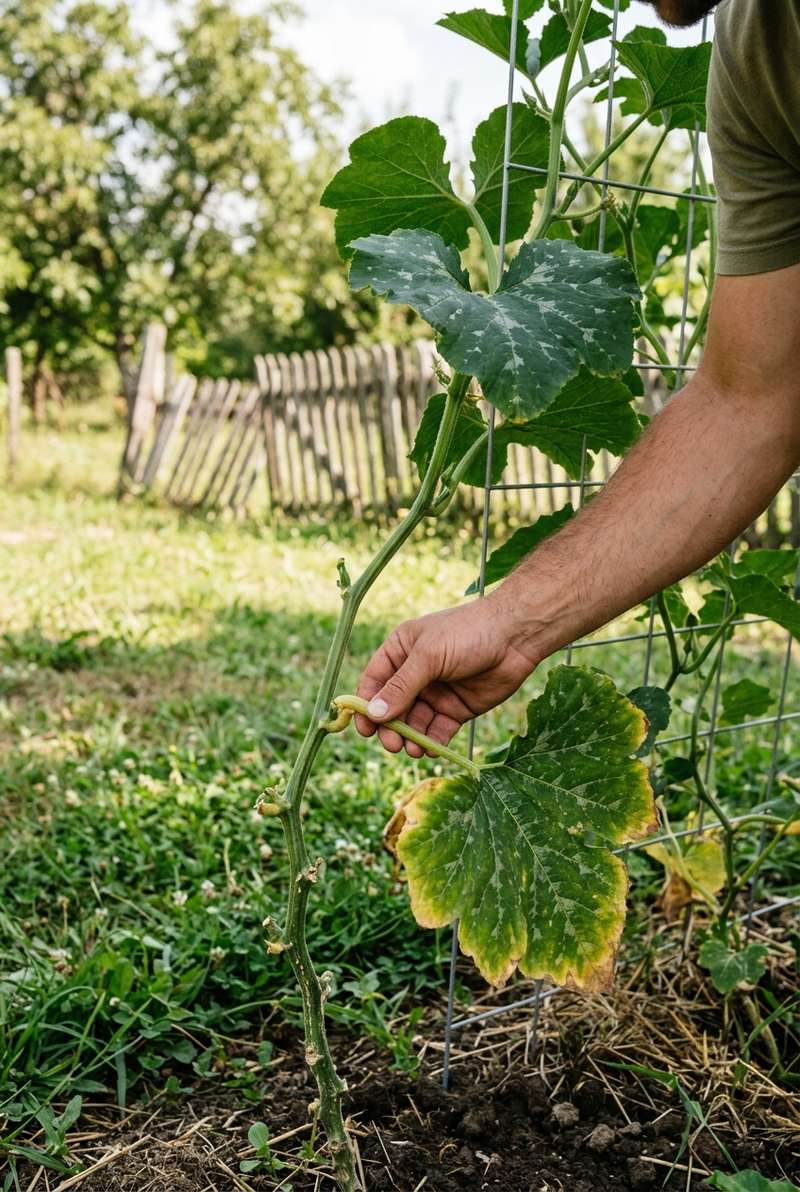
Vertical growing helps with powdery mildew. It doesn’t fix it.
The lowest leaves still trap humidity right where the plant meets the soil, and that’s where mildew gets started. Strip the bottom 2 or 3 leaves once the plant hits about 3 ft (90 cm) tall, and keep stripping the lowest ones every week or two as the vine climbs.
Two more rules that matter.
- Water at soil level only. Never overhead. A long-spout watering can or drip line is the difference between a clean plant and a mildewed one by August.
- Keep at least 24 to 36 inches (60 to 90 cm) between vertical zucchini plants. Crowding kills airflow, and crowding cancels out the whole point of growing vertical in the first place.
If you’re growing in a raised bed, this is a good moment to make sure the soil is in shape. Vertical zucchini is a heavy feeder and will run a depleted bed flat in about two months. I wrote up how I recharge tired raised-bed soil if yours has had a few seasons on it.
When Vertical Actually Wins (and When It Doesn’t)
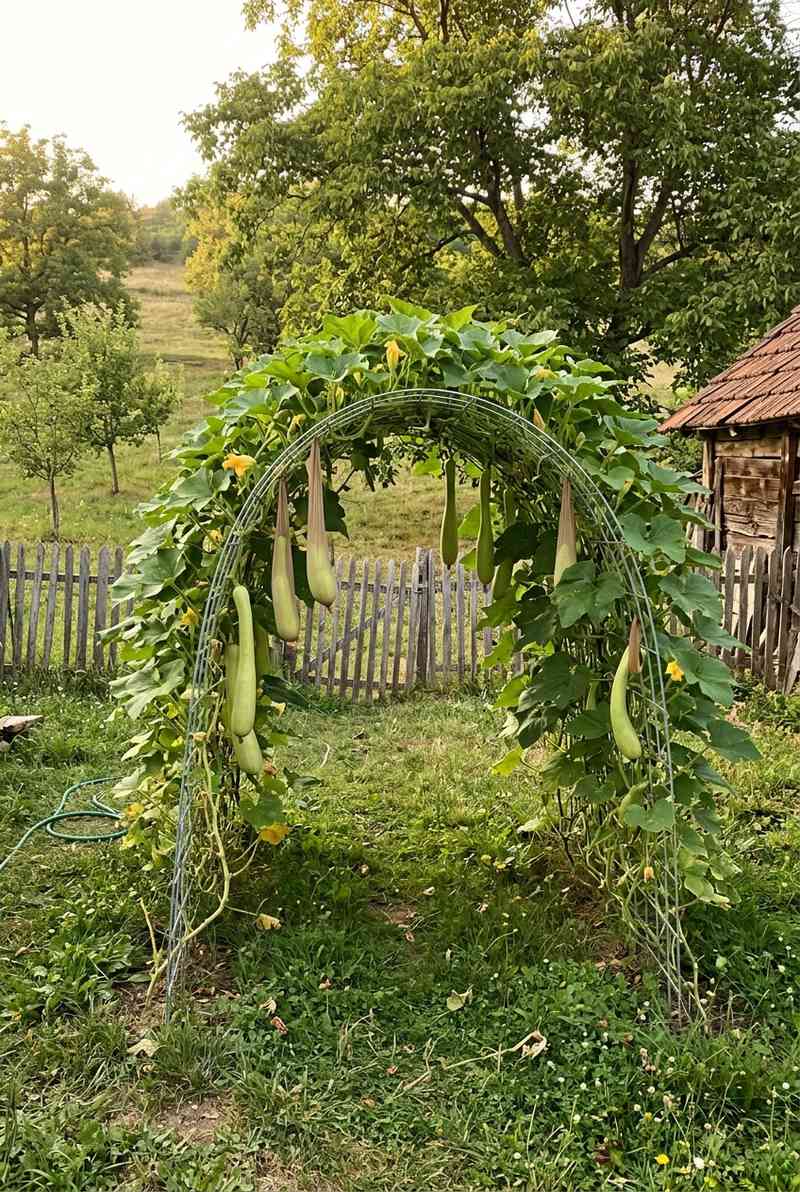
Vertical zucchini is worth the effort if your garden is small, if you’ve been losing plants to powdery mildew every year, or if you want one tidy visual feature instead of a sprawling patch that eats half a bed.
It’s not worth the effort if you already have plenty of ground space and your standard zucchini does fine, or if all you have right now is Black Beauty seeds and no real interest in buying new ones. Honest answer.
If you’ve never grown zucchini at all, get one ground-season under your belt first. Vertical is a layer on top of zucchini fundamentals, not a beginner’s first project.
And if you grow one vining type this season, grow Tromboncino. It’s the variety I’d hand a friend who’s just starting.
Quick Questions
Does Tromboncino actually taste like zucchini?
Close, but firmer and slightly nuttier. Harvested young at 8 to 12 inches (20 to 30 cm), it grills and sautées like zucchini. Left on the vine to mature, it turns into a butternut-style winter squash you can store for months. Two crops in one variety, basically.
Can I grow vertical zucchini in a pot?
Yes, but the pot has to be at least 18 inches (45 cm) wide and deep, and the trellis has to be anchored to a fence or wall, not the pot itself. A potted vine plus a 6 ft trellis is top-heavy and will tip in any wind. My container gardening guide covers pot-size math in more detail.
Do I have to prune side shoots like a tomato?
No, and I’d ignore most online advice telling you to. There’s a lot of guidance circulating that says to prune zucchini side shoots aggressively, and I haven’t found a single university extension source backing it up. Strip the bottom 2 or 3 leaves for airflow, and leave the rest alone unless you’re literally running out of trellis space.
Grow Tromboncino. Build a support that won’t tip. Sling the fruit before it needs slinging, and pollinate before the morning gets away from you. That’s most of what kept mine producing into September.