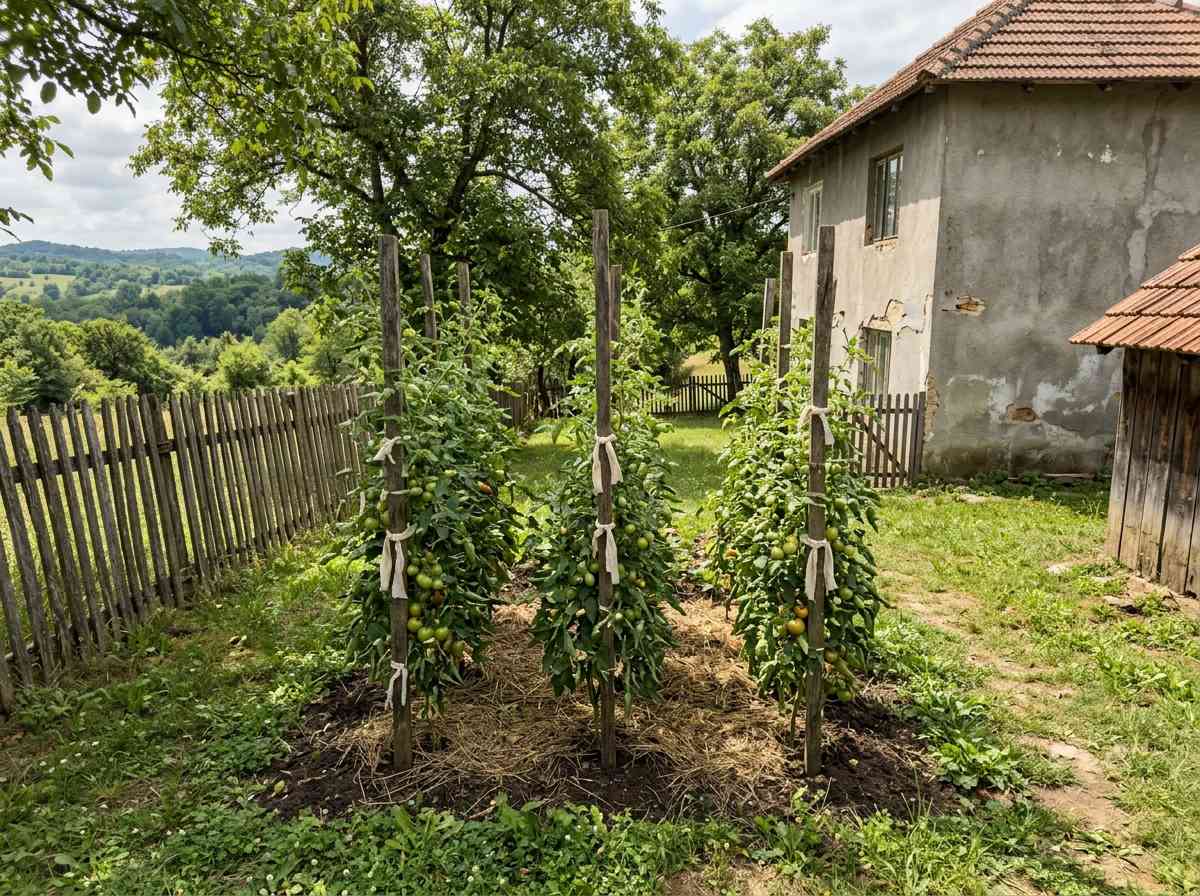
How to Prune Tomato Plants (Without Killing Your Harvest)
- Beginner Friendly
- Edibles
- Summer Care
- Disease Prevention
I lost half a Roma harvest my second year of gardening because I “pruned” it the same way I pruned my Cherokee Purples.
Whacked every sucker off the plant like a champ.
Felt very responsible.
Turns out Roma is a determinate tomato, and those side shoots I was pinching off were the actual fruiting branches.
The fix was one sentence someone should have told me on day one. Here’s what actually works, and the small handful of mistakes that cost the most when you skip them.
Read This Part First
- Determinate tomatoes (Roma, Celebrity, Bush Early Girl): mostly leave them alone
- Indeterminate tomatoes (Sungold, Brandywine, Cherokee Purple): pinch suckers regularly
- Prune only when leaves are dry, in the morning
- Keep leaves above every fruit cluster to prevent sunscald
- Two-stem is what I use for most varieties.
First, Figure Out Which Tomato You’ve Got
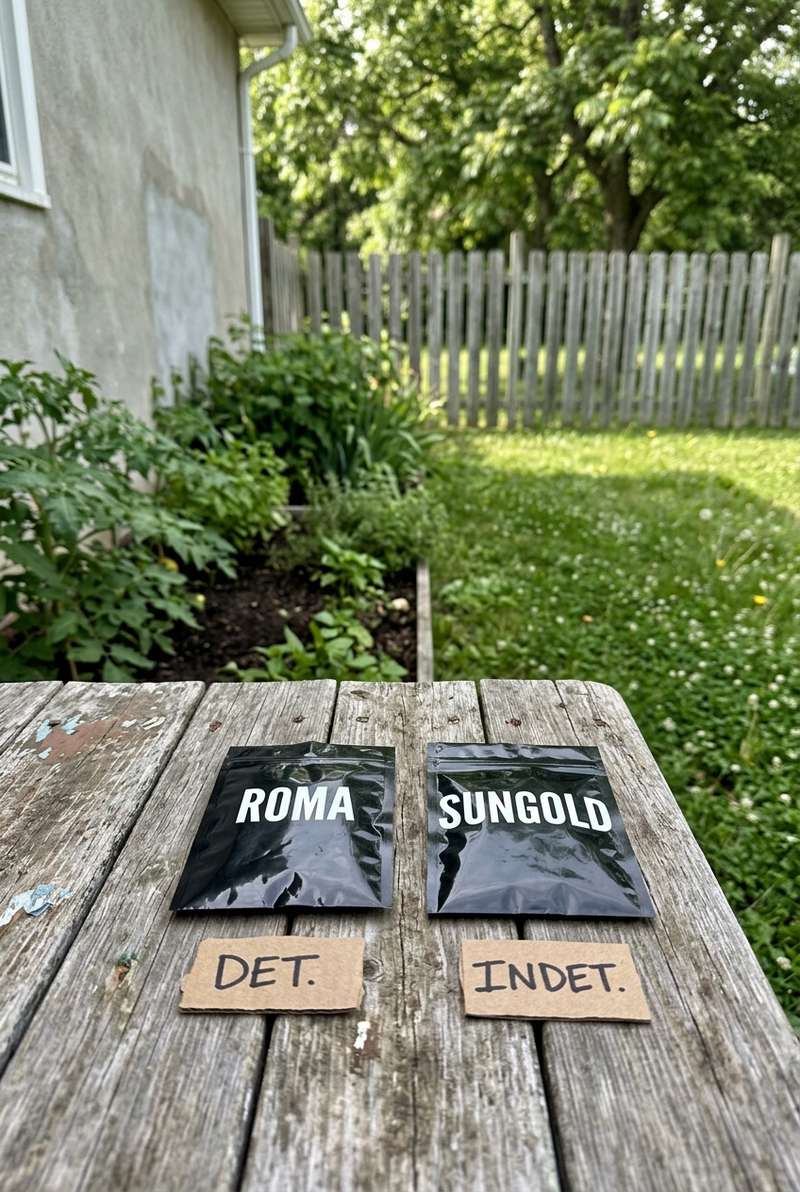
If you get one thing right in this article, this is it.
Tomatoes come in two shapes: determinate (bush-type, all the fruit ripens roughly at once) and indeterminate (vining, keeps producing until frost kills it).
Most seed packets say which one you’ve got. If you started your plants from seed, the packet is your fastest way to check.
If yours doesn’t say, a 30-second search of the variety name does the trick.
Determinate examples: Roma, San Marzano (yes, that San Marzano), Celebrity, Bush Early Girl, Patio. These stop growing when they set flower clusters on top.
Indeterminate examples: Sungold, Sweet 100, Brandywine, Cherokee Purple, most heirlooms. These keep pushing new growth all summer.
There’s a middle group called semi-determinate. For pruning purposes, treat those like determinates.
| Type | Growth habit | Pruning approach |
|---|---|---|
| Determinate | Stops at a set height (3-4 ft / 90-120 cm) | Barely prune. Only up to first flower cluster. |
| Indeterminate | Keeps growing until frost | Pinch suckers, remove bottom leaves, top before frost. |
| Semi-determinate | Somewhere between | Treat like determinate. |
I lost that Roma harvest because nobody told me the varieties fall into two groups. Don’t skip this part, even if the rest of the article makes your eyes glaze over.
What a Sucker Actually Is (And Where to Find It)
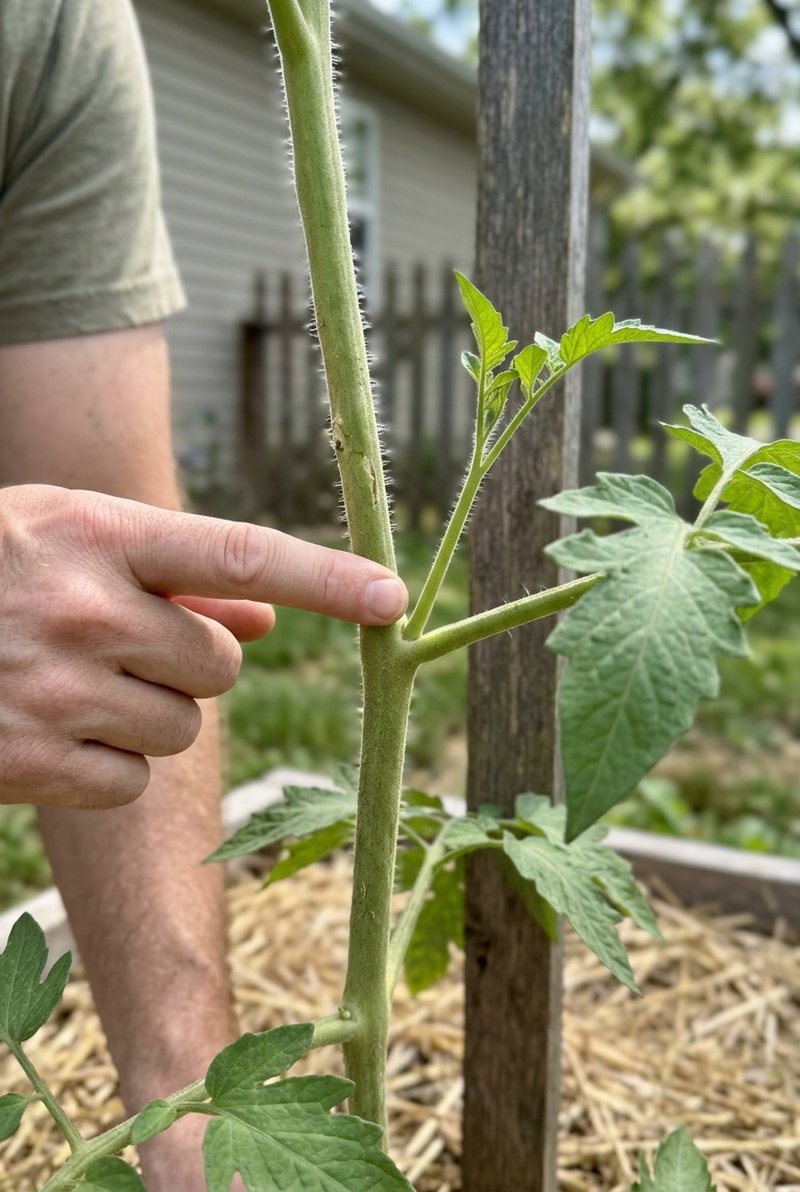
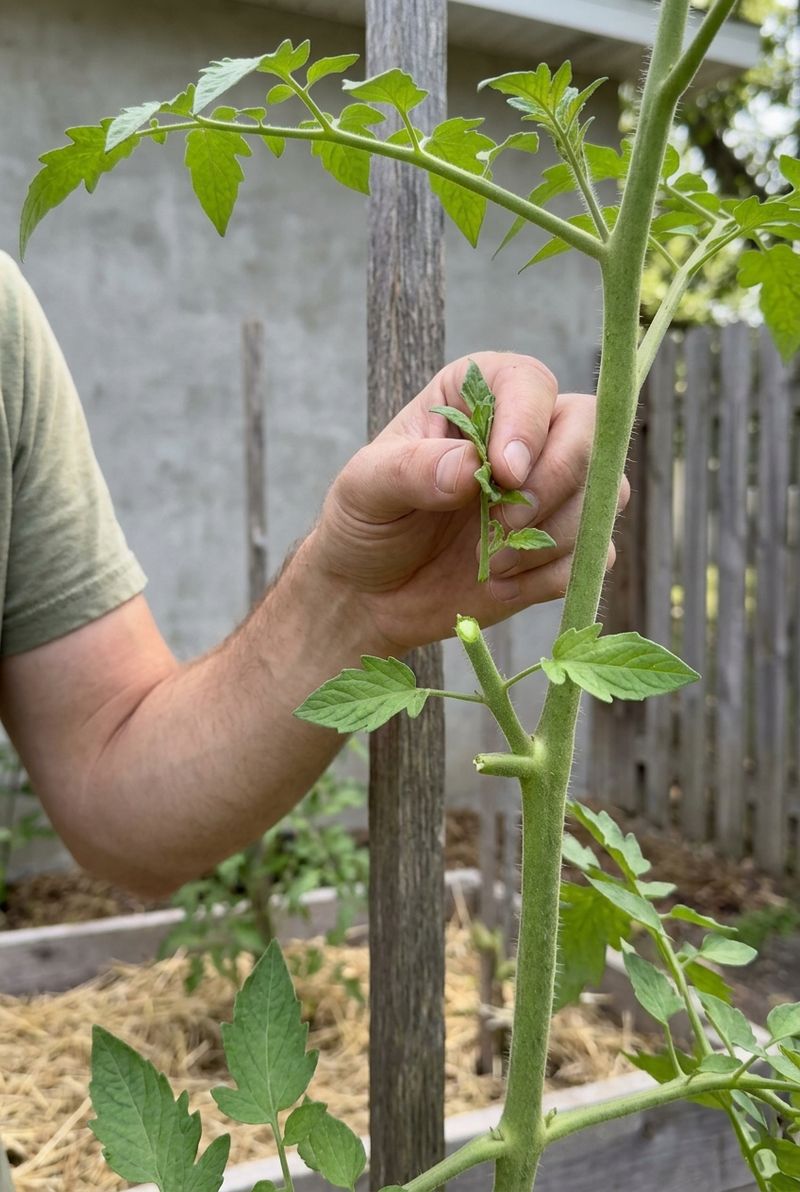
A sucker is the little branch that grows in the armpit of the plant.
If you look at the main stem, you’ll see a real leaf branching off to the side. In the V-shape between that leaf and the main stem, another branch pushes out.
That new branch is the sucker.
Some people call them side shoots. Same idea.
Left alone, a sucker turns into a full second stem with its own leaves and flowers. On an indeterminate, you’ll have a small tree in a month if you don’t touch it.
Pinch them when they’re 2 to 4 inches (5 to 10 cm) long. Small ones snap off with a fingernail.
Bigger ones need clean pruners, and they leave a bigger wound.
The word jungle is what beginners on gardening forums use when they realize they skipped this step for two weeks. Same idea.
The One Rule for Determinates: Mostly Leave Them Alone
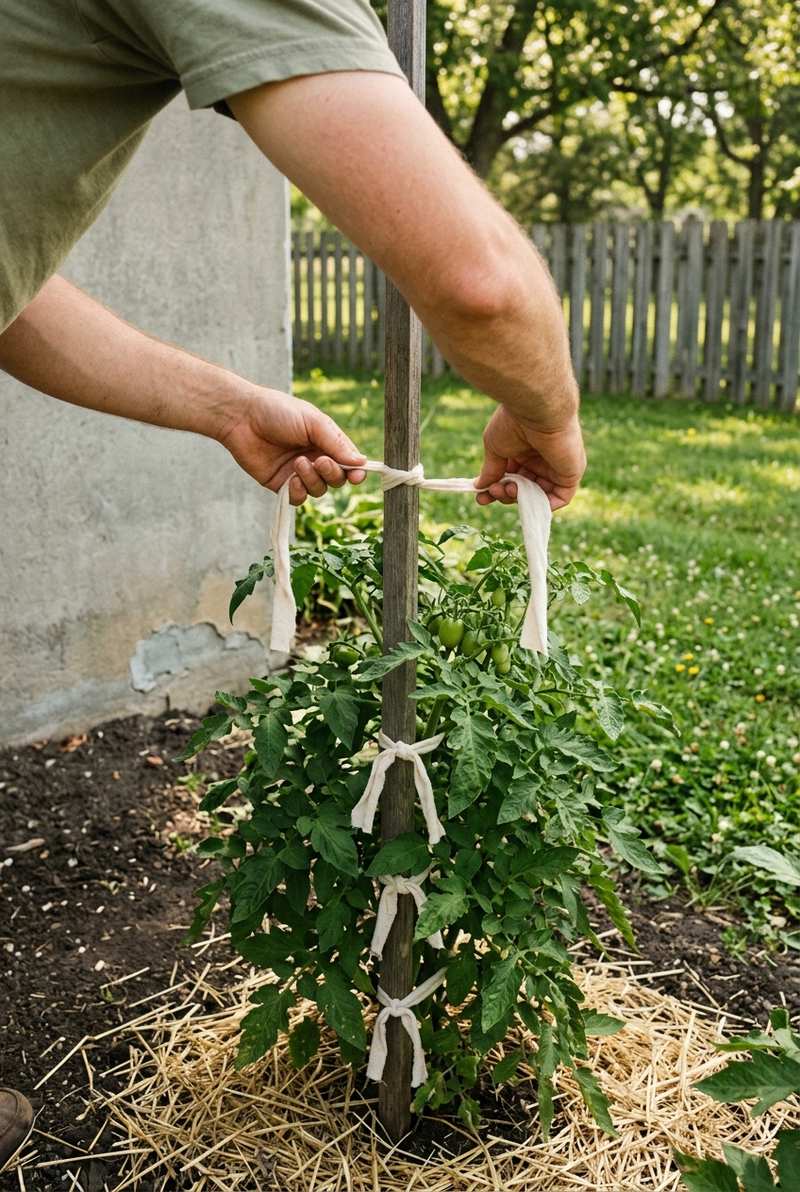
Iowa State Extension puts it plainly: on determinates, remove suckers only up to the first flower cluster. Everything above that is the fruiting wood.
If your plant is knee-high and you see the first cluster of yellow flowers, take off any suckers below that cluster to improve airflow at the base.
Then stop.
That’s really the whole determinate pruning routine.
If you keep pinching suckers above the first flower cluster on a Roma, you’re cutting off the fruit before it forms.
Purdue trial data showed pruned single-stem plants can lose over a third of their total yield by weight compared to unpruned ones. On a determinate, that math gets uglier because there’s no new growth to replace what you took.
This is the mistake I made in year two. Now I tie determinates to a stake, clean up the bottom leaves, and walk away.
Common mistake
Never prune tomato plants when the leaves are wet. Fungal and bacterial spores stick to open cuts and spread between plants on wet pruners. Wait for a dry morning. If you can wait for two dry mornings in a row, even better.
For Indeterminates: Pinch Small, Not Big
Indeterminates are where pruning actually earns its keep.
Once the plant is about 12 to 18 inches (30 to 45 cm) tall and pushing flowers, start checking it every 4 or 5 days. Any sucker between 2 and 4 inches gets pinched off.
Small ones I pop off with a thumbnail. Anything thicker than a pencil, I switch to bypass pruners and wipe the blades with 70% rubbing alcohol, 30 seconds between plants (Wisconsin Horticulture Extension).
Sounds fussy.
Cost me a whole plant to tomato mosaic virus once (worth the extra 30 seconds), so now I don’t skip it.
Morning pruning heals faster than evening. Dry leaves, not wet ones.
If it rained overnight, wait for the sun to burn the dew off before you go out there.
Skip the pruning session entirely if the plant is already stressed. Sunscorched, waterlogged, wilted, or flowering hard, leave it alone for a week and come back.
Same rules apply in a container as in a bed. If yours is growing in a large container, airflow matters even more since the plant sits closer to walls and other pots.
The Missouri Pruning Trick (When the Sucker Got Away)
Sometimes life gets in the way. Toddler-nap window collapses, weekend gets busy, and suddenly the sucker you meant to pinch is 6 inches long with its own baby leaves.
Cutting that off leaves a wound the size of your fingernail.
Missouri Pruning is the workaround. Instead of cutting the whole sucker off, you pinch off just the tip and the newest leaves, leaving two leaves on the sucker as a stub.
Two things happen. The stub keeps photosynthesizing, so the plant doesn’t lose that energy.
And in hot climates, those retained leaves shade nearby fruit and stop sunscald from turning your tomatoes into white papery patches.
It’s not a trick every article mentions, and it should be. This is the method I’d go with anytime a sucker gets past 4 inches.
Did you know
Missouri Pruning trades one big wound for one small pinch. The two-leaf stub closes over faster, the sucker no longer competes for energy, and the retained leaves shade nearby fruit against sunscald. In hot climates, that shade is the difference between clean red tomatoes and pale patchy ones.
Single Stem vs. Two Stems (What I Actually Do)
There are three ways to train an indeterminate: single-stem, two-stem, or “let it be a shrub.”
Single-stem means one main leader, every sucker removed. You get the biggest individual tomatoes and the fewest total pounds.
This is a greenhouse and commercial-grower move.
Two-stem means you keep one sucker (usually the strongest one just below the first flower cluster) and let it grow as a second main leader. Every other sucker gets pinched off.
This is the sweet spot for most home gardens.
Multi-stem or “shrub” style means you let more than two leaders grow inside a cage. You get the most total fruit but the smallest individual tomatoes, plus the most disease pressure because airflow gets ugly.
I go two-stem for beefsteaks and slicers. For cherry tomatoes I’ve stopped pruning aggressively at all.
Cornell ran a cherry-tomato trial and found the two-leader plants beat both single-stem and heavily pruned plants on yield per hour of work.
Cherry tomatoes don’t need the surgery. Give them a big cage, some ties, and let them be a bush.
Pruned plants grow bigger tomatoes. Unpruned plants grow more pounds. It’s a trade, not a free lunch.
Suckers get most of the attention. The bigger disease problem starts down at the soil line.
The Leaves at the Bottom (When to Take Them Off)
Any leaf touching the soil is a disease highway.
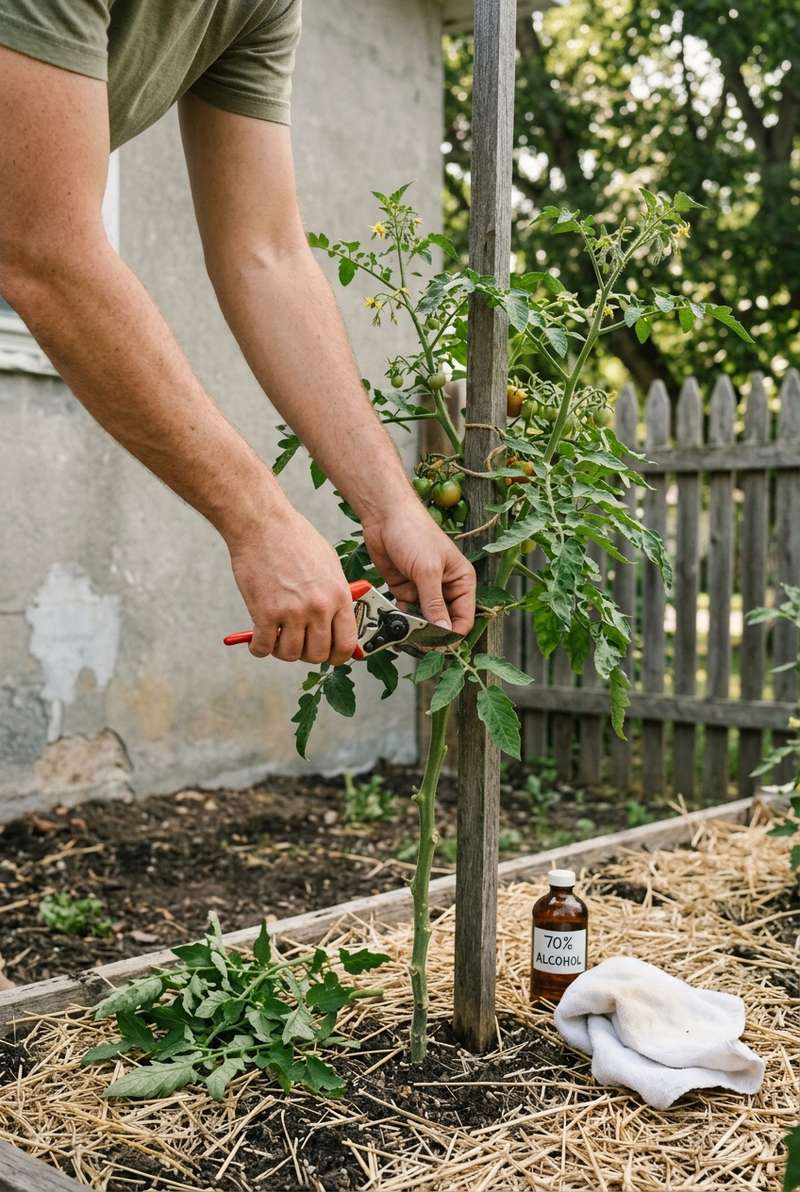
Early blight and septoria leaf spot both spread when rainwater splashes soil onto low leaves. The fix is boring and effective: once your plant hits about 2 feet (60 cm) tall, strip the leaves off the bottom 12 inches (30 cm) of stem.
Do this in the same dry-morning window as your sucker pinching. Same rubbing-alcohol routine between plants.
One rule that stops most sunscald problems: keep one or two full leaves right above every fruit cluster.
Those leaves feed the fruit directly and shade it from direct sun. Strip them and you get white papery patches on the ripening tomatoes.
If splash-back from tired soil is a big problem in your beds, a compost top-up and a straw mulch fixed mine. If the bed itself is the issue, recharging your raised bed soil lowers disease pressure faster than any pruning routine ever will.
When to Stop: Topping Before First Frost
Every fall I forget to do this. Every fall I lose a chunk of green tomatoes to the first hard frost.
Roughly 30 days before first frost, cut the top off every indeterminate. Take off the growing tip, any new flower clusters, and any tiny fruit that clearly won’t ripen in time.
You’re telling the plant to stop pushing new growth and put its energy into finishing the fruit that’s already there.
This is the section most articles skip. Nothing fancy about it.
Just a calendar reminder that pays off at the end of the season with one last round of red tomatoes instead of green ones.
Five Ways People Mess This Up
Every one of these came out of forum threads or my own compost pile.
- Pruning determinates. Roma, Celebrity, Bush Early Girl. If you’re pinching the tops off these varieties, stop.
- Pruning wet plants. Morning dew or post-rain is when fungal spores travel fastest. Wait for dry leaves.
- Ripping big suckers with fingers. A 6-inch sucker torn off with a twist can strip bark down the main stem. Clean pruners only, or Missouri prune it instead.
- Removing more than a third of foliage at once. Fast route to sunscald and stress. Space major pruning at least a week apart.
- Confusing flower trusses with suckers. A flower cluster grows out from the main stem, not from a leaf axil. If it has tiny yellow buds on it, it’s fruit. Leave it.
I’ve done at least three of these myself, and one of them twice. Don’t skip the wet-plant one.
What Fixed My Yields the Next Year
The year after I killed that Roma harvest, I stuck a piece of blue painter’s tape on each stake with either “leave alone” or “pinch suckers” written on it.
Silly-looking. Extremely effective.
That’s really the whole thing.
Know which tomato you’ve got, pinch small on the indeterminates, dry mornings only, and leave the leaves above the fruit alone. Everything else is fine-tuning.
Next year I’m going to try single-stem on one beefsteak, just to see the giant-tomato thing for myself. I’ll write up how it goes.