10 Narrow Evergreen Trees for Privacy in Small Yards

- Year-round privacy
- Real widths
- Zones 2-9
- Spacing for a screen
The house behind mine has a second-floor window that looks straight into my backyard.
I like my neighbors. I just don’t need them watching me weed in pajamas.
The problem is width. My side of the fence has maybe six feet of soil before the lawn starts.
So I went looking for narrow evergreen trees that could close the view without eating the yard. These 10 grow tall, stay green all winter, and most stay 10 feet (3 m) wide or less.
Quick Summary
- 10 narrow evergreen trees for a year-round screen, grouped by family: junipers, spruces and pines, arborvitae and kin, broadleaf
- Every table gives width, height, zones and the weak point
- The extension rule for spacing trees in a privacy row
- Two popular screen trees that grow far too wide for a small yard
- Best starter pick: Spartan juniper. Hardy in zones 4-9, 15 to 20 feet (4.5 to 6 m) tall but only 4 to 5 feet (1.2 to 1.5 m) wide, and it tolerates deer and drought.
How Far Apart to Plant a Screen
This is where most privacy rows go wrong.
An Ask Extension expert puts the general rule simply: space evergreens no closer than their mature width. Crowd them and the trees grow into each other and lose their shape, and once they touch you may end up taking out every other one.
So a row of trees that each grow 5 feet (1.5 m) wide goes in about 5 feet (1.5 m) apart, trunk to trunk.
It looks gappy for a few years (I know, I hated it too). Then it closes.
And trust the width, not the word “columnar.” The University of Maryland Extension notes that plenty of upright evergreens end up 3 to 5 feet (0.9 to 1.5 m) wide or more at the bottom.
The skinniest classics, like Emerald Green arborvitae, Taylor juniper and Italian cypress, are already in my tall skinny trees list. This one is about the next options when those don’t fit your zone or your taste.
Junipers for Sun and Drought
Tough, dense and not fussy about soil. Junipers want full sun, and they’re the two I’d start with on a dry, hot fence line.
1. Spartan Juniper
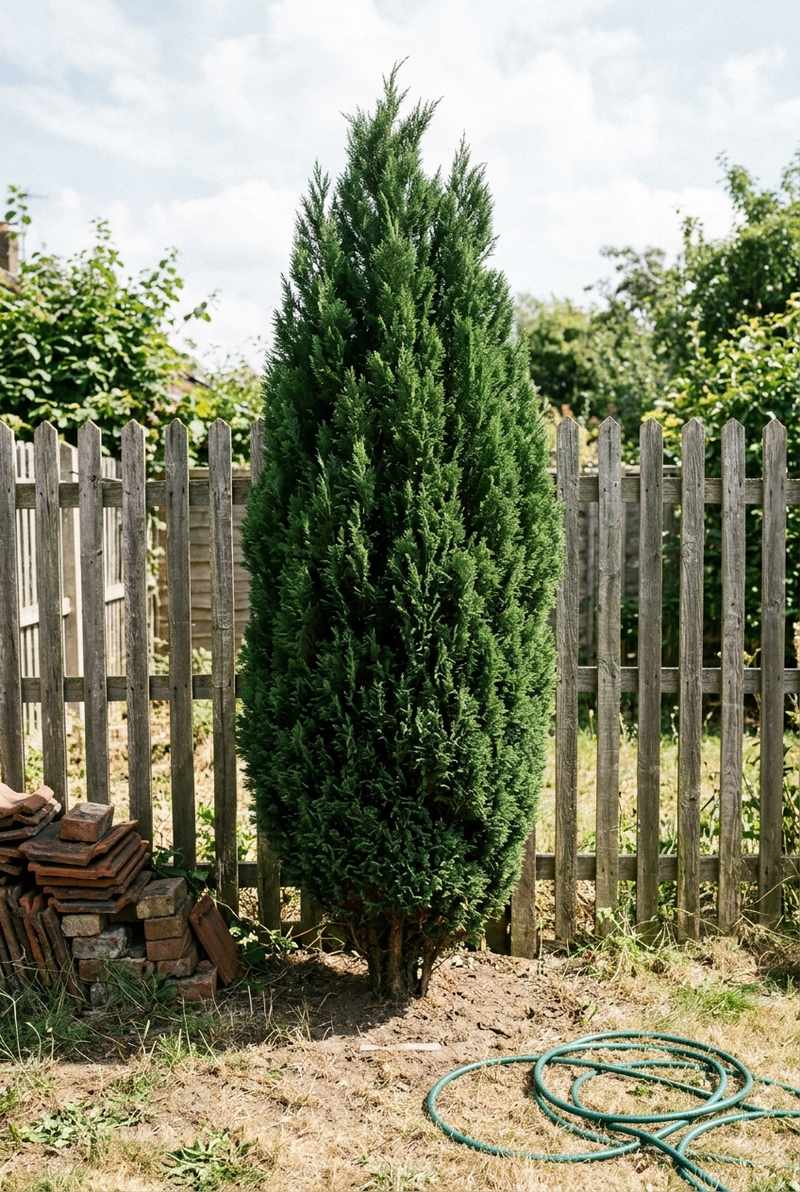
My starter pick for most yards.
Spartan is a narrow, pyramidal to columnar juniper, 15 to 20 feet (4.5 to 6 m) tall and only about 5 feet (1.5 m) wide. Missouri Botanical Garden lists it as tolerant of deer, drought and rocky soil, and it’s hardy all the way from zone 4 to zone 9.
Two cautions come with most junipers. Cedar-apple rust spends part of its life on them, and root rot can show up in wet, poorly drained soil.
2. Hillspire Eastern Red Cedar
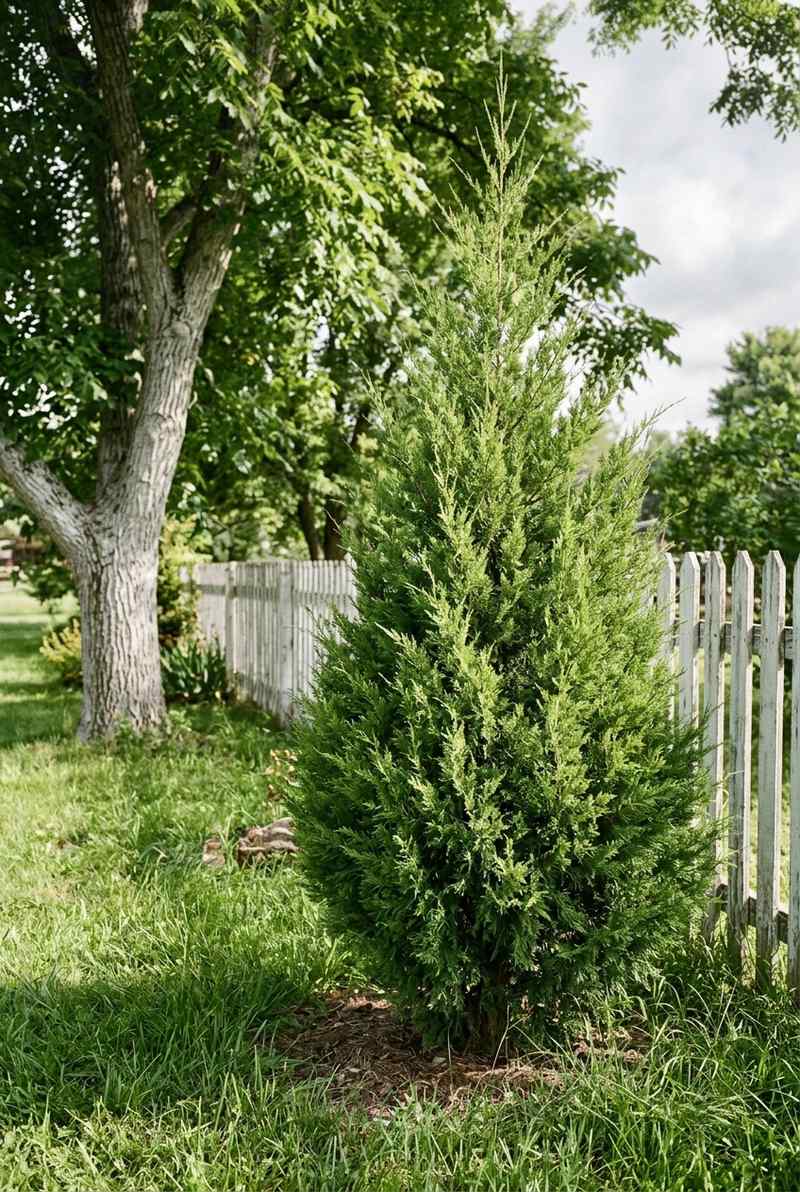
The cold-climate juniper, hardy down to zone 2.
Hillspire is a dense, symmetrical pyramid with bright green foliage all year. It grows 15 to 30 feet (4.5 to 9 m) tall, and Missouri Botanical Garden gives a wide range for spread, 5 to 15 feet (1.5 to 4.5 m), so give it more room than Spartan.
It’s a male cultivar, so no berries. It tolerates black walnut, which matters if a walnut tree shades your fence line, and it shares the usual juniper troubles: cedar-apple rust and bagworms.
Spruces and Pines for Cold Winters
For cold winters and summers that stay reasonably cool, where a spruce feels at home.
3. Cupressina Norway Spruce
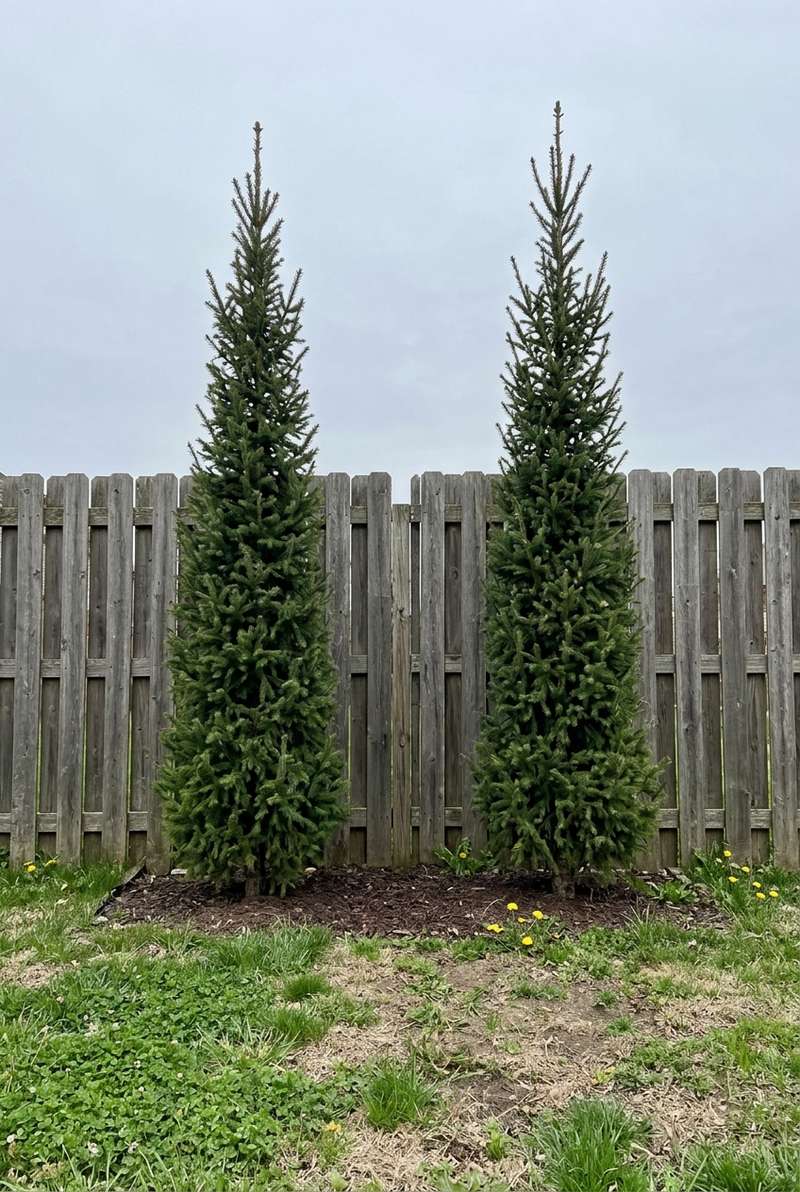
A Norway spruce that forgot to spread out.
Oregon State lists it at a mature height of about 30 feet (9 m) but only 4 feet (1.2 m) across at the bottom, with branches that sweep steeply upward. It grows about 1 foot (30 cm) a year.
The needles are dark green and turn a little bluish in winter. It was found in Germany’s Thuringian Forest before 1904, and it’s hardy to zone 3.
4. Bruns Serbian Spruce
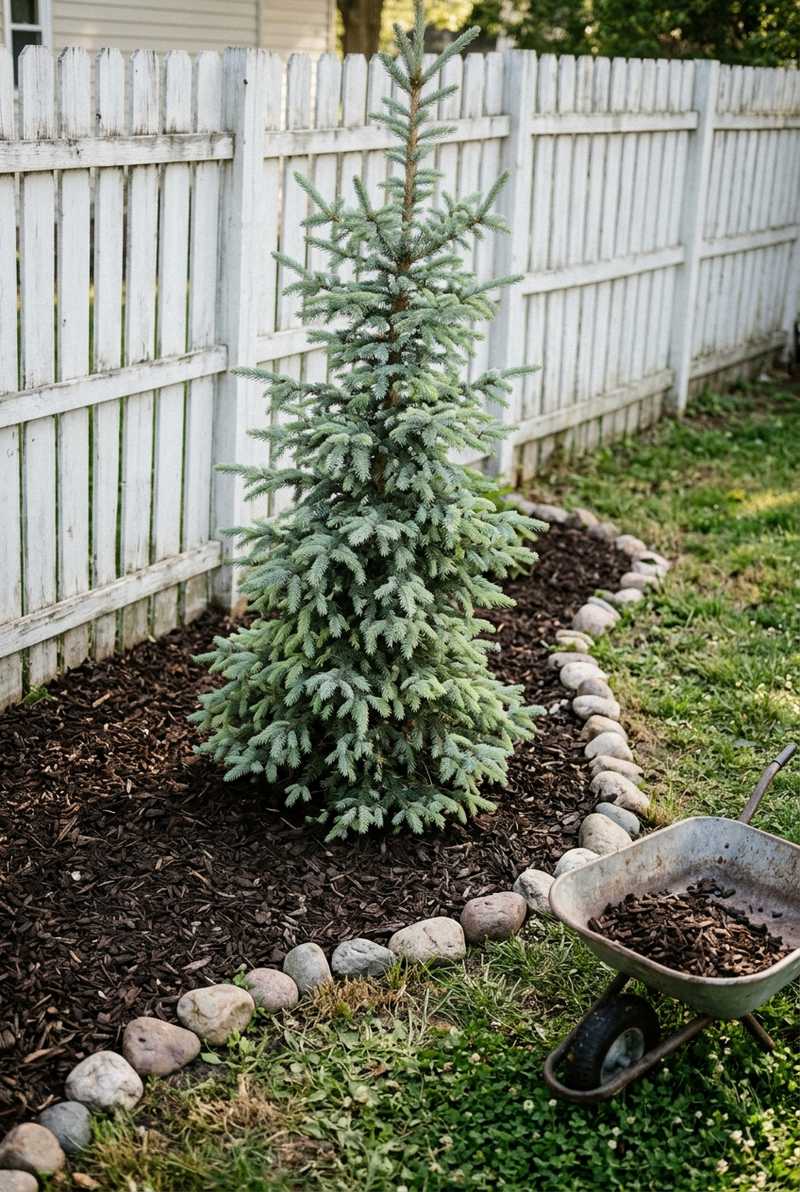
The one with a story (and, full disclosure, my favorite here).
Oregon State calls Bruns very narrow, about 14 feet (4.3 m) tall and 4 feet (1.2 m) wide after 10 years. That’s the only size the page gives, and spruces keep growing, so treat it as a starting point.
The species was found in 1875 growing on limestone cliffs in the Tara and Javor Mountains, and NC State says it’s now listed as endangered in its native country. Omorika is a Serbian word for “slender,” though NC State notes some sources say it simply means “spruce.”
Bruns wants deep, rich, moist soil that drains well.
5. Columnar Scotch Pine
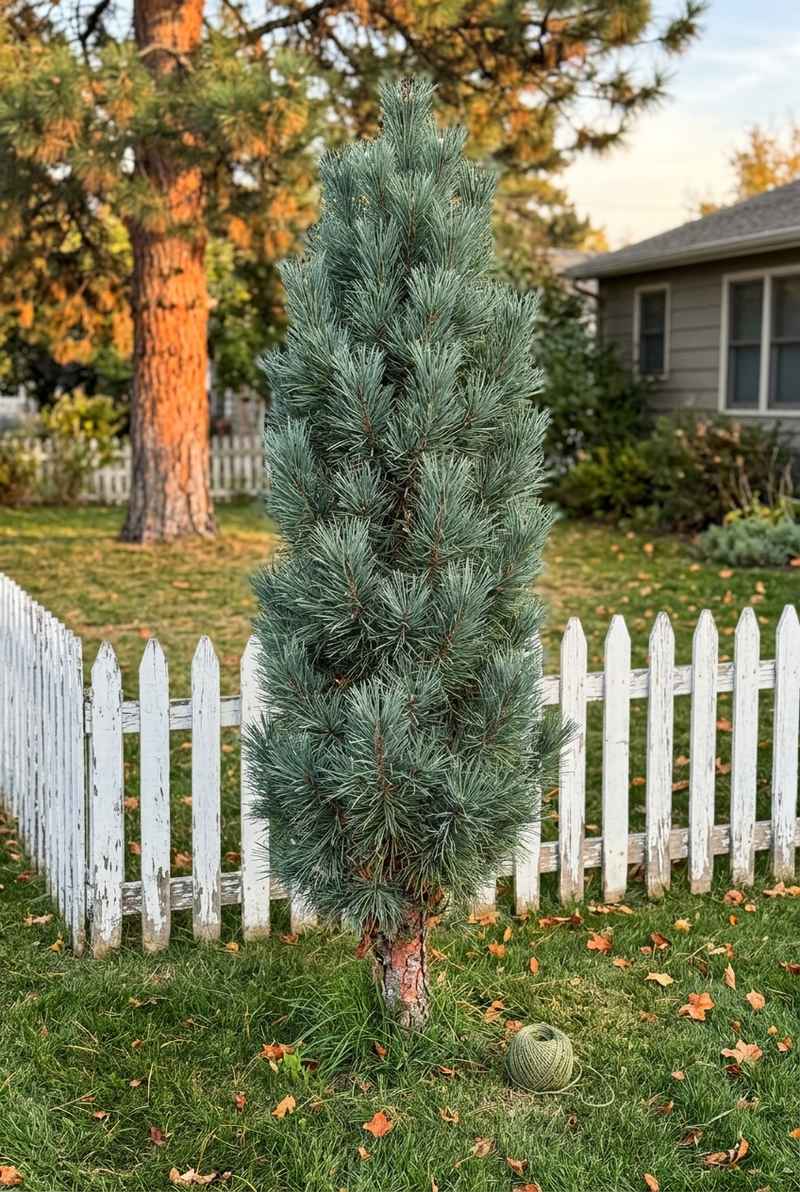
A pine for the gardener who wants needles instead of scales.
It grows 20 to 25 feet (6 to 7.5 m) tall and 6 to 8 feet (1.8 to 2.5 m) wide. Missouri Botanical Garden says Scots pines prefer cool summers and don’t care for Deep South heat and humidity.
The weak spot is winter. It’s susceptible to snow, ice and wind damage.
Tip
Missouri Botanical Garden suggests tying the branches of this pine together for winter. I use soft garden twine, spiraled loosely from the bottom up, and take it off in spring so it doesn’t cut into the bark.
Arborvitae, Yew and Cedar
Soft, scaly or flat foliage, and more tolerance for shade than the groups above.
6. Dark American Arborvitae
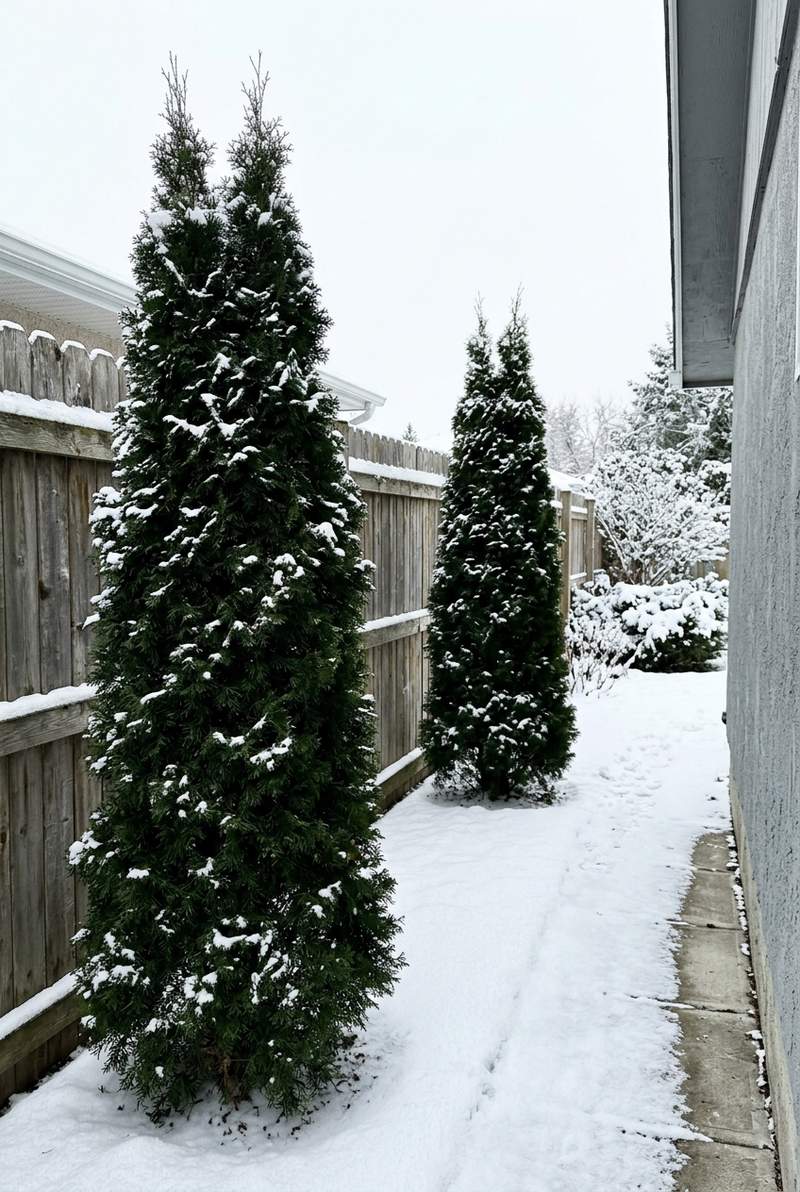
A taller, darker arborvitae for a screen that has to reach higher.
Nigra is a conical arborvitae, 20 to 30 feet (6 to 9 m) tall and 5 to 10 feet (1.5 to 3 m) wide. Its foliage stays dark green through winter.
Deer are the big catch. An Ask Extension expert calls eastern arborvitae very palatable to browsing deer, and says browsed foliage won’t regrow, so a row can lose its bottom five or six feet (1.5 to 1.8 m).
Add winter burn and snow breakage from the Missouri Botanical Garden page, and I’d only plant it where deer never visit.
7. Irish Yew
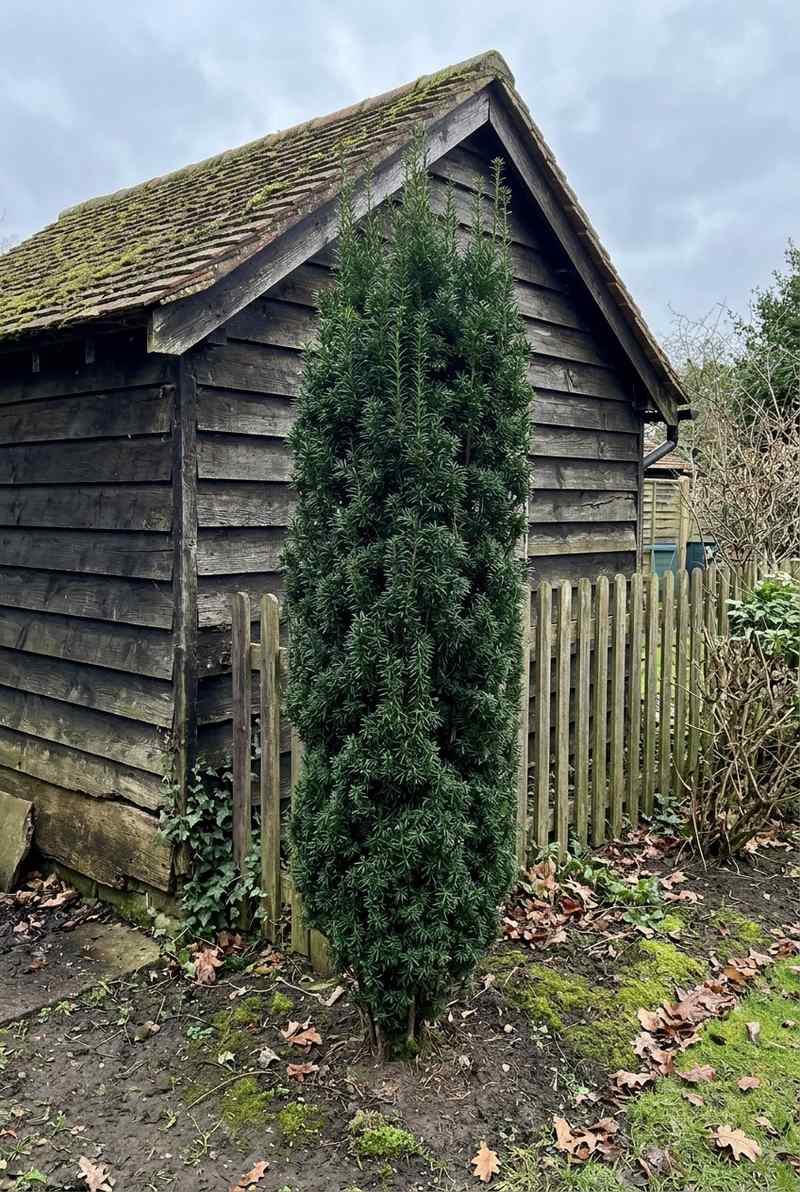
The shade-tolerant one, with a serious warning.
Irish yew is narrowly columnar with rigidly upright branches, 15 to 30 feet (4.5 to 9 m) tall and 4 to 8 feet (1.2 to 2.5 m) wide. Oregon State says it takes sun or shade, and that a farmer in Northern Ireland’s County Fermanagh found it around 1780.
Here’s the warning. NC State rates English yew as having high severity poison characteristics and tags it as a problem for children, cats, dogs and horses.
I have a three-year-old who tastes everything, so I didn’t plant one anywhere near the yard she plays in.
8. Incense Cedar
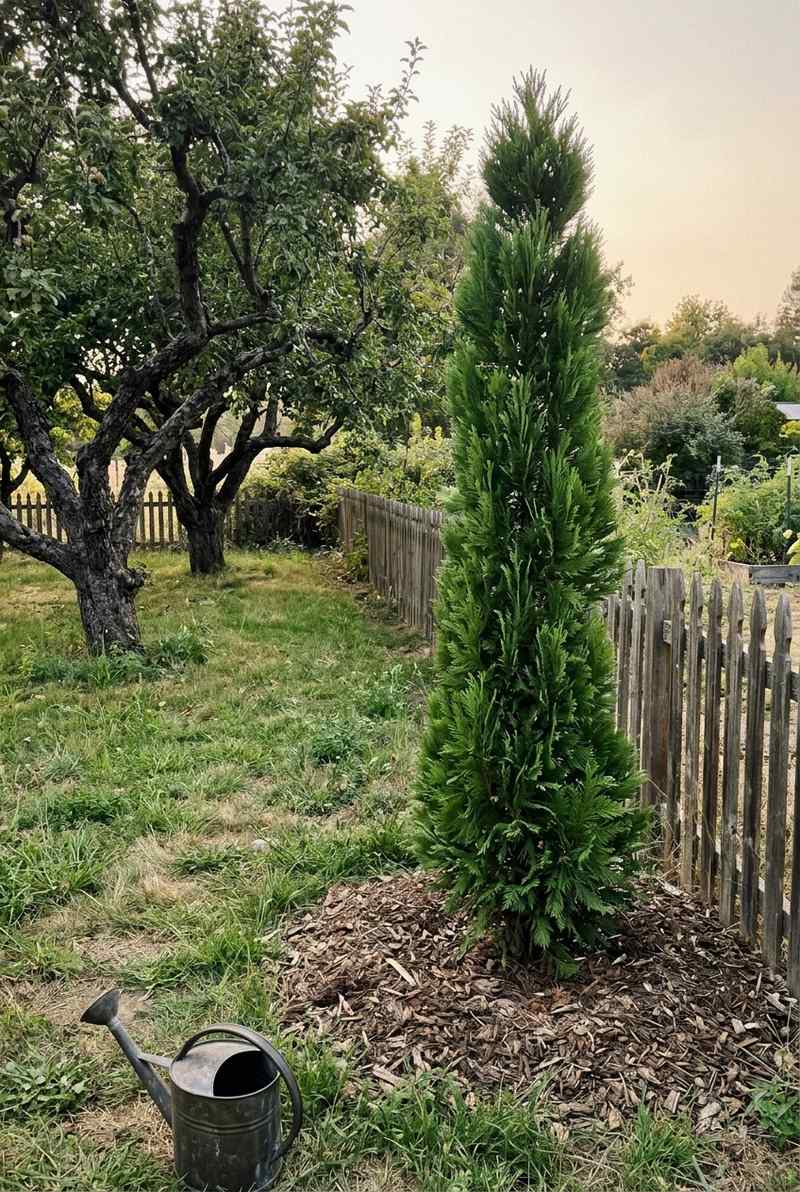
The tallest tree on the list, and the one to plant where height matters more than anything.
Missouri Botanical Garden lists 30 to 50 feet (9 to 15 m) tall and 8 to 10 feet (2.5 to 3 m) wide (NC State gives an even bigger range). The foliage smells aromatic when you crush it.
NC State says it typically doesn’t develop winter burn, a real advantage over arborvitae. The catch: it’s difficult to transplant, so buy it small and water deeply while it settles in.
Broadleaf Screens for Mild Winters
Leaves instead of needles, and flowers or berries as a bonus. Dragon Lady handles zone 6; Fortune’s osmanthus wants 7 or warmer.
9. Fortune’s Osmanthus
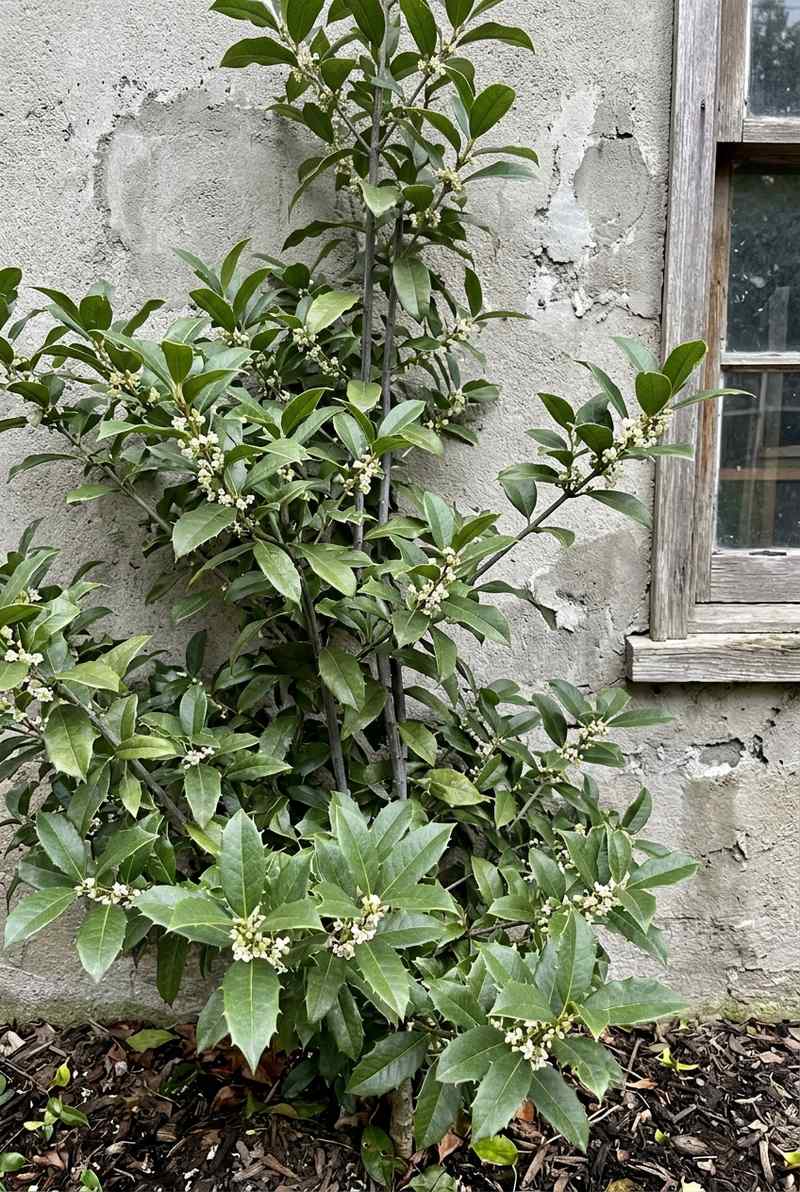
A screen that smells good.
It’s an old Japanese hybrid of fragrant tea olive and false holly, 15 to 20 feet (4.5 to 6 m) tall and 6 to 10 feet (1.8 to 3 m) wide. NC State tags it for fragrant white flowers and lists it as deer resistant.
It grows slowly, so start with the biggest plants you can afford. Keep the soil from staying soggy, since root rot can follow.
10. Dragon Lady Holly
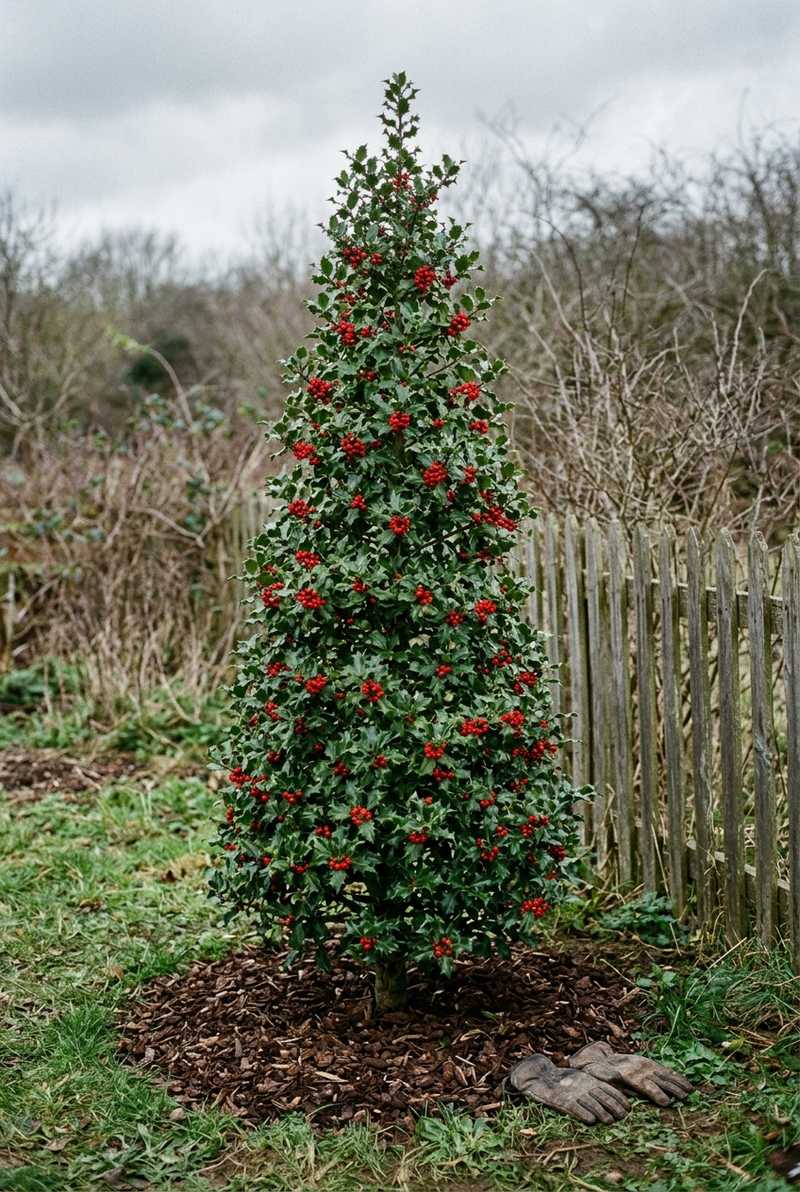
My last pick, and the prettiest screen here in winter.
Missouri Botanical Garden describes Dragon Lady as upright and symmetrical, a “very narrow pyramid” 10 to 20 feet (3 to 6 m) tall and 4 to 6 feet (1.2 to 1.8 m) wide. Scarlet berries ripen in fall and hang on through winter against spiny, dark green leaves.
It’s a female holly, so for berries it needs a male nearby, such as Blue Stallion or Blue Prince. And the spines make it a screen nobody cuts through.
Sold as a Screen, Grows Like a Barn
Two trees show up in almost every privacy hedge. Neither belongs in a narrow yard.
| Tree | Mature size (NC State) | Why I’d skip it here |
|---|---|---|
| Green Giant arborvitae | 40-60 ft tall, 12-18 ft wide (12-18 x 3.5-5.5 m) | NC State warns it can quickly grow very large and become a problem in a space that’s too small |
| Leyland cypress | 60-70 ft tall, 10-15 ft wide (18-21 x 3-4.5 m) | NC State calls it problematic and suggests alternatives; its root rots and cankers are incurable |
If your strip is only 5 or 6 feet (1.5 to 1.8 m) wide, either one will be pressing on the fence and the house within a few years.
Questions About Narrow Evergreen Trees
Which narrow evergreens do deer leave alone?
Spartan juniper and Hillspire red cedar are listed as deer tolerant, and Fortune’s osmanthus as deer resistant. Arborvitae is the opposite: deer love it.
What can I plant for privacy in shade?
Irish yew takes sun or shade. Dark American arborvitae, Dragon Lady holly, incense cedar and Fortune’s osmanthus all handle part shade.
Which one is the narrowest?
Cupressina Norway spruce, about 4 feet (1.2 m) across at the bottom, and Bruns Serbian spruce at about 4 feet (1.2 m) after 10 years. Spartan juniper is close behind at 4 to 5 feet (1.2 to 1.5 m).
What if I only have room for shrubs?
Then look at my tall narrow shrubs, which stay around 15 feet (4.5 m) or less and fit beds 3 to 5 feet (0.9 to 1.5 m) wide.
The Window Is Gone
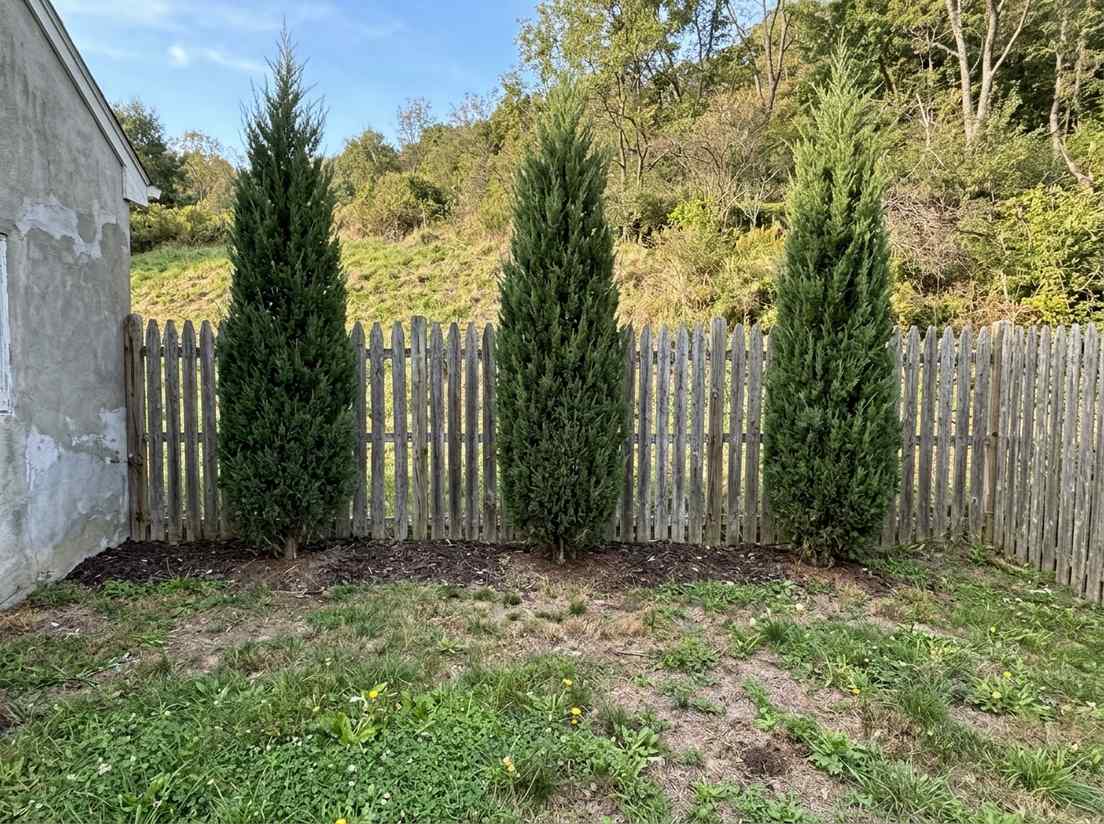
Three Spartan junipers now stand between my yard and that second-floor window. It took a few summers of gaps, but the view is closed.
Measure your strip, plant at the mature width, and wait. For drooping shapes instead of columns, my weeping evergreen trees are another way to block a view.
The widths here come from Missouri Botanical Garden, Oregon State and the NC State Extension Plant Toolbox, so check your exact cultivar there before you buy.