10 Small Trees to Plant Near the House (and How Close Is Safe)

- Front of house
- Distance for each tree
- Zones 3-9
- Roots explained
The house came with a maple planted about eight feet from the front corner. By the time I got here its branches were scraping the gutter, and every windy night sounded like someone dragging a rake across the roof.
Whoever planted it wasn’t careless. They just looked at a five-foot sapling and couldn’t picture forty feet of tree.
So this list of small trees to plant near the house starts with the tape measure. Ten trees, sorted from “right under the window” to “give it some room,” with the minimum distance worked out for each.
Quick Summary
- 10 small trees that suit a spot near the house, sorted by how close they can go
- Each entry lists mature size and the minimum trunk-to-wall distance
- Extension experts say branches are a bigger worry than roots for small trees
- Three trees to keep well away from any building or pipe
- Best starter pick: Star magnolia. Slow, compact, zones 4-8, and happy with as little as 5 to 7.5 feet (1.5 to 2.5 m) from a wall.
What Roots Actually Do
I expected horror stories. The extension sources are calmer than the internet.
Purdue’s forestry extension explains that when roots meet something solid like a foundation, they’re redirected sideways or up and over. If there’s already a crack or a leak nearby, they’ll find it and move in.
Pipes, they say, aren’t broken by roots. The roots are just very good at locating leaks.
A Michigan extension expert adds the caveat that matters: they’ve seen roots physically move foundations, but only where a tree had been left to grow a few feet from the wall.
And then there’s this, from New Mexico State University’s extension, answering a homeowner with the same worry: “The roots should not be as great a concern as the branches.”
That matched my gutter exactly.
How Close Is Too Close
Nobody agrees on one number, so here are three rules and where each comes from.
| Rule | Where it comes from | For a tree 12 ft (3.5 m) wide |
|---|---|---|
| Bare minimum: half the mature spread | Plain geometry. Any closer and branches grow into the wall | 6 ft (1.8 m) |
| Comfortable: the full mature spread | My own rule. Room to walk behind it and paint the siding | 12 ft (3.5 m) |
| Ideal: twice the mature spread | A Colorado extension answer, which admits small yards often can’t manage it | 24 ft (7 m) |
Each tree below shows the bare minimum as “Trunk to wall.” Treat it as the line you don’t cross, not the target.
Tip
Stand where the tree will go and hold your arms out to the mature width. If you can touch the house, the tree will too.
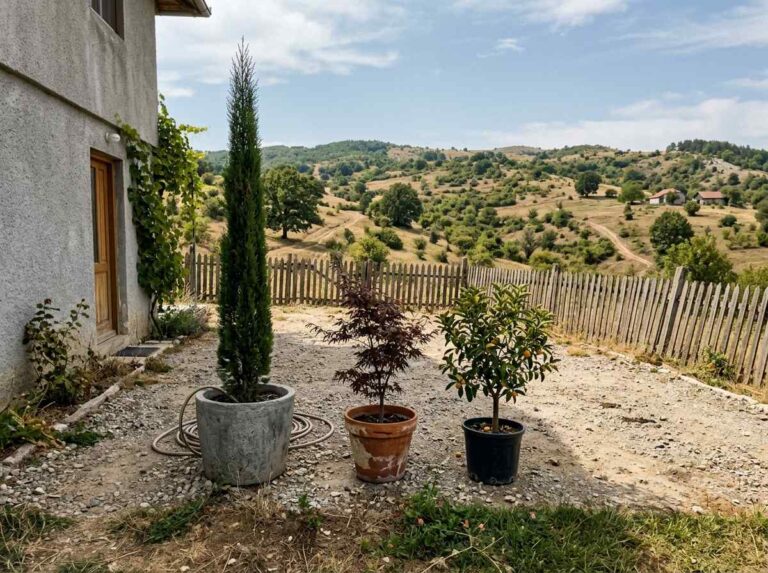
1. Dwarf Hinoki Cypress
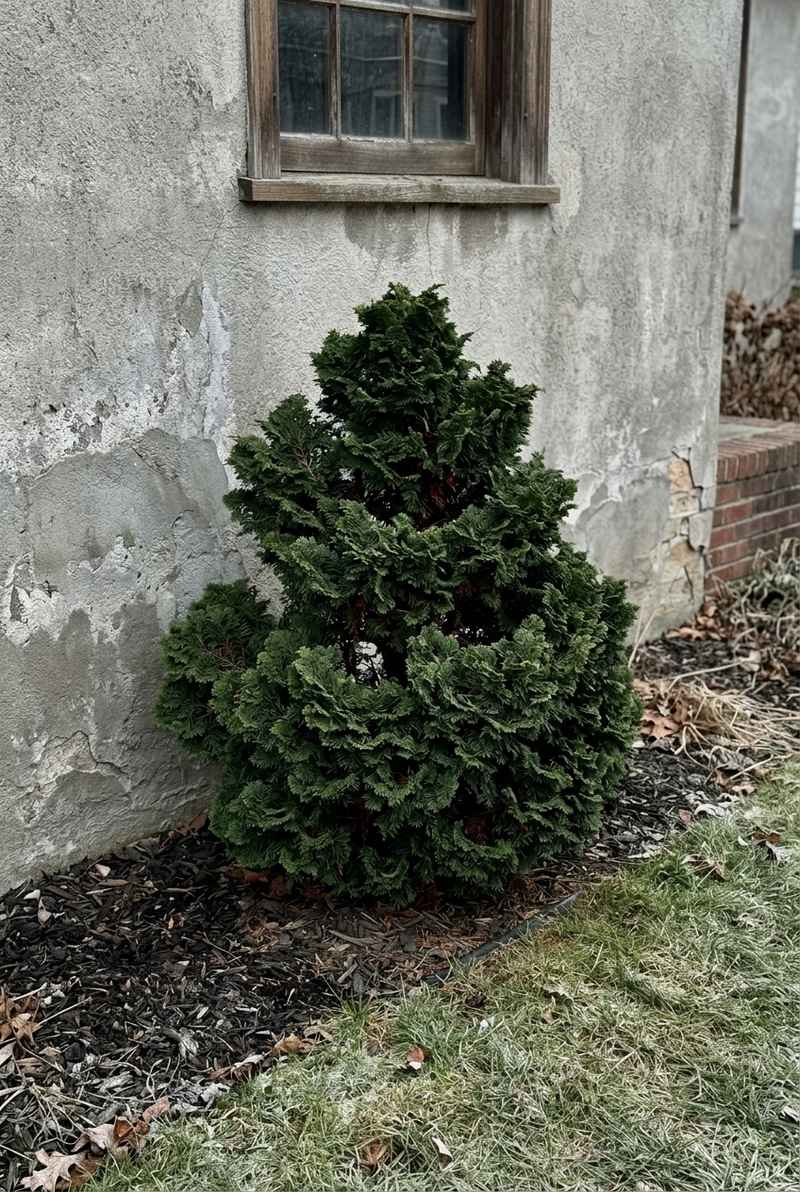
The one tree here that can sit right under a window.
It’s a dwarf, slow-growing evergreen with graceful, dark green foliage. In ten years it reaches only 3 to 4 feet (about 1 m), and eventually around 6 feet (1.8 m) with a spread of 2 to 4 feet (60 to 120 cm).
Give it a spot protected from harsh wind. Full sun suits it best, though it takes part shade.
2. Little Gem Magnolia
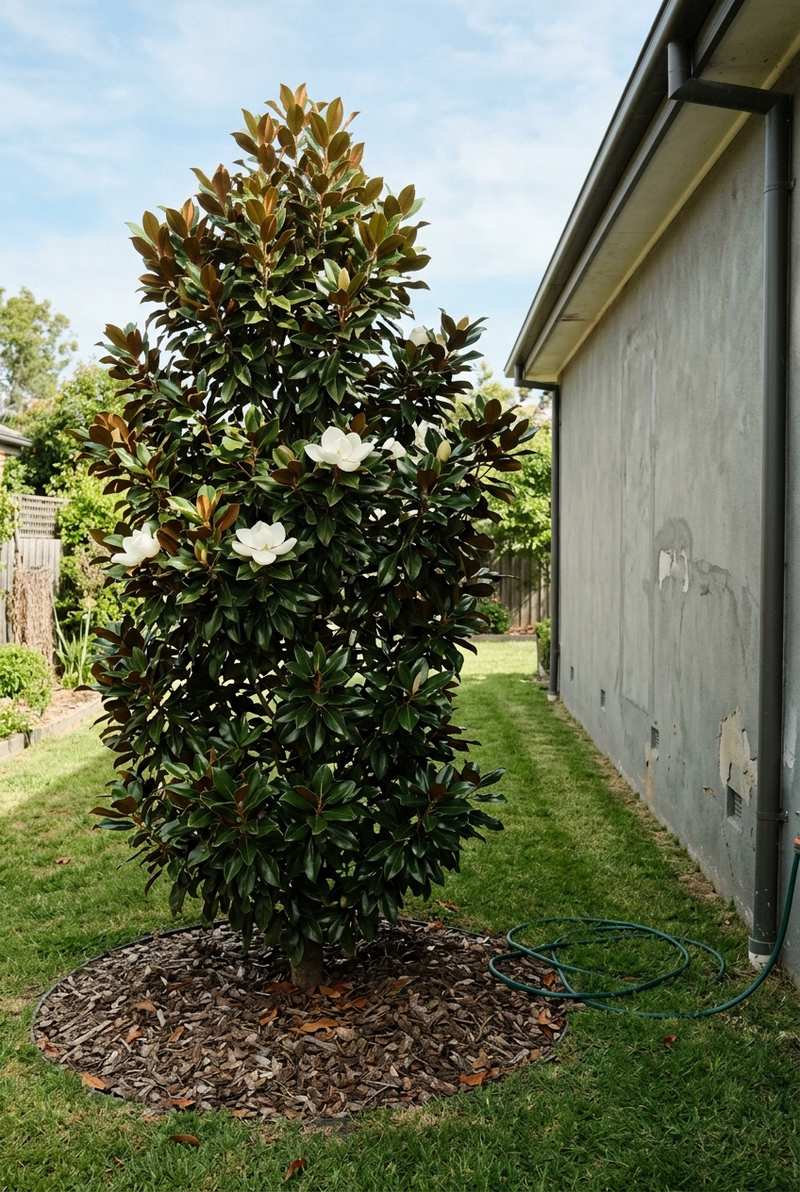
A southern magnolia that fits beside a front door. For years I assumed that wasn’t possible.
‘Little Gem’ grows as a compact, upright evergreen, reaching about 20 feet (6 m) over its first twenty years and only 8 to 10 feet (2.5 to 3 m) wide. The flowers are fragrant and up to 4 inches (10 cm) across.
It’s reliable in zones 7 through 9. In a harsh winter it can drop its leaves, and it dislikes soil that’s very dry or very wet.
3. Yaupon Holly
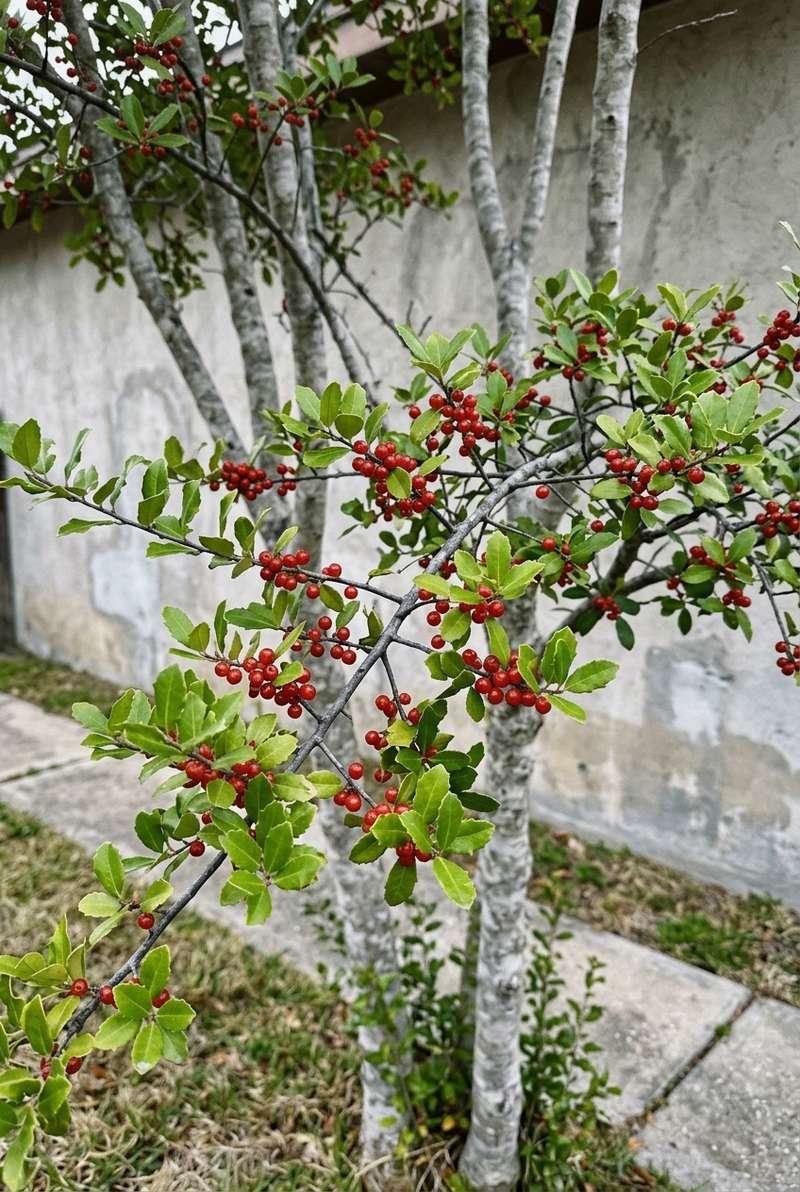
The toughest evergreen on this list, and a native.
Yaupon grows in anything from full sun to deep shade, and it withstands drought, salt spray and occasional flooding. It also takes heavy pruning, which is exactly what you want from a plant near a walkway.
For the bright red berries you need a female plant with a male nearby. (The berries are for the birds, not for people.)
4. Star Magnolia
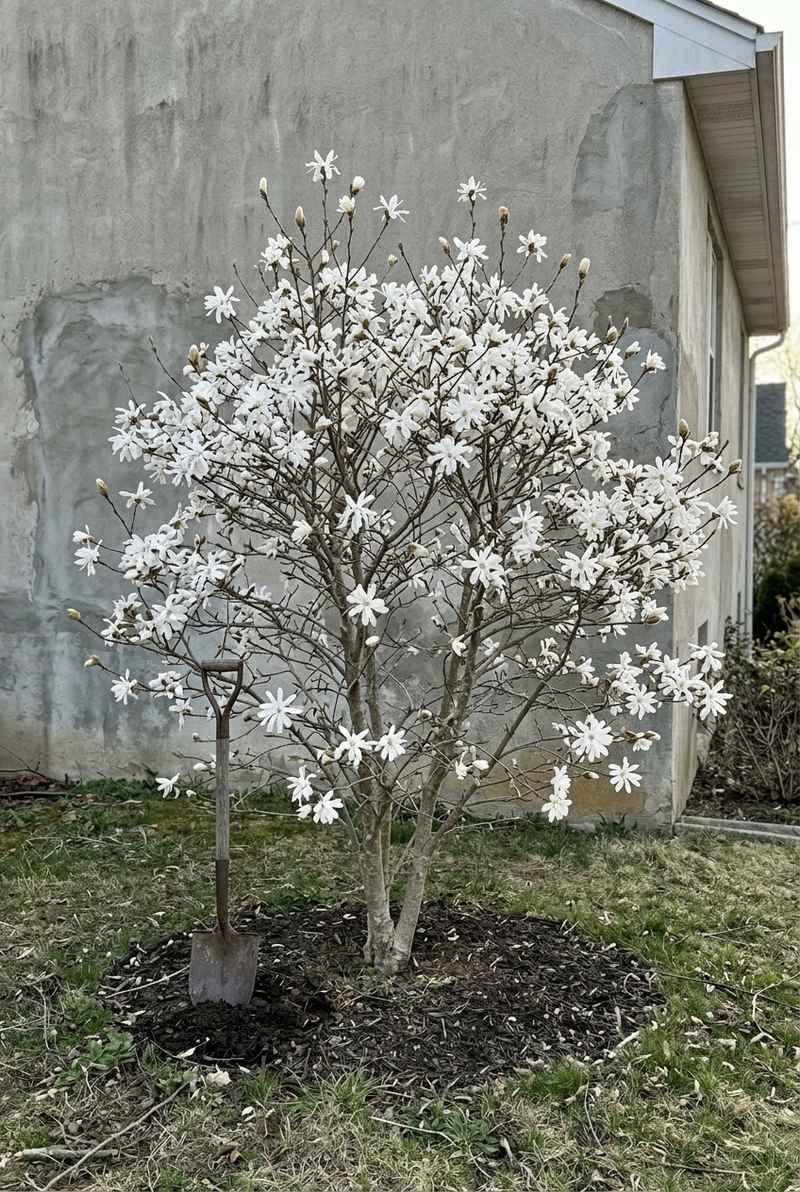
My starter pick for a house corner.
It’s slow-growing and compact, 15 to 20 feet (4.5 to 6 m) tall and 10 to 15 feet (3 to 4.5 m) wide, and it’s the earliest deciduous magnolia to flower. White, star-shaped, fragrant blooms open in late winter to early spring.
That early bloom is the risk, since a hard frost can damage the flowers. It also yellows in alkaline soil.
5. Downy Serviceberry
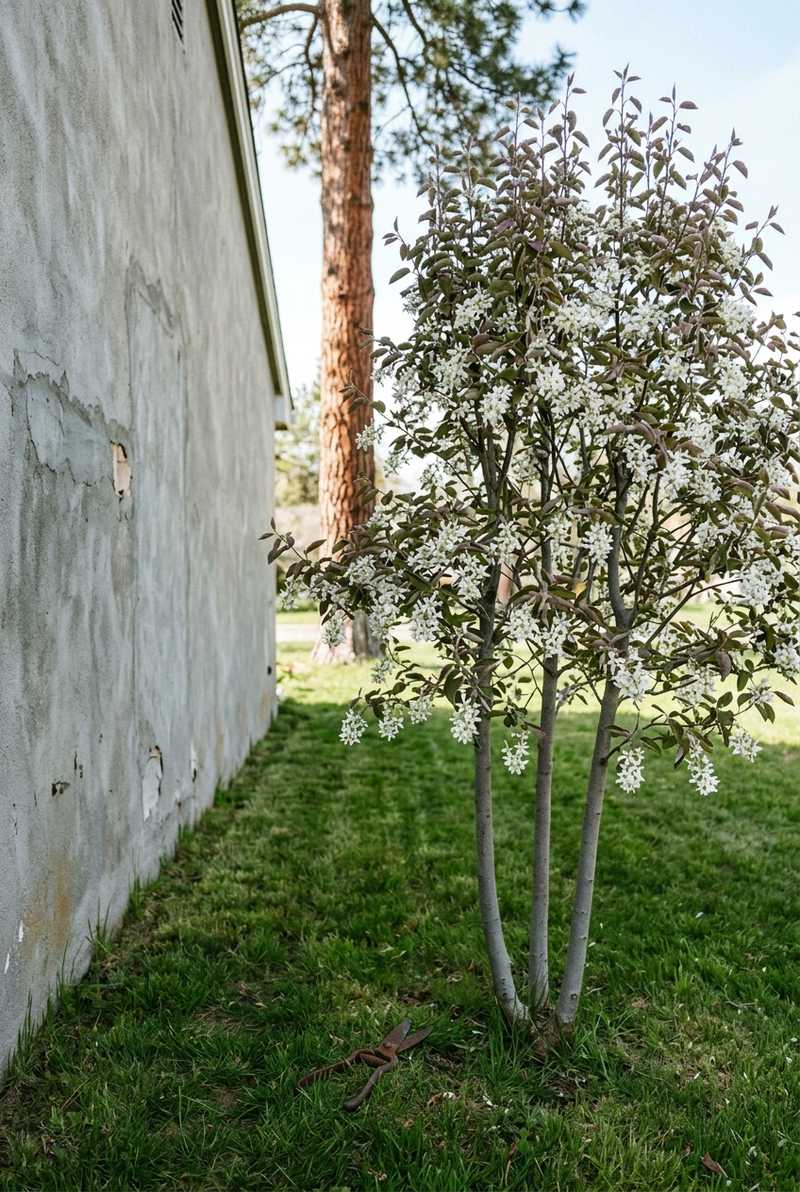
A native with a narrow, rounded shape, which makes it one of the easiest trees to tuck beside a wall.
It grows 15 to 25 feet (4.5 to 7.5 m) tall but only 10 to 15 feet (3 to 4.5 m) wide, and it handles a wide range of soils, from sandy to clay. Fragrant white flowers open in spring.
Cut out the root suckers as they appear. Leave them and it turns into a wide shrub, which defeats the point of planting it close.
6. Sourwood
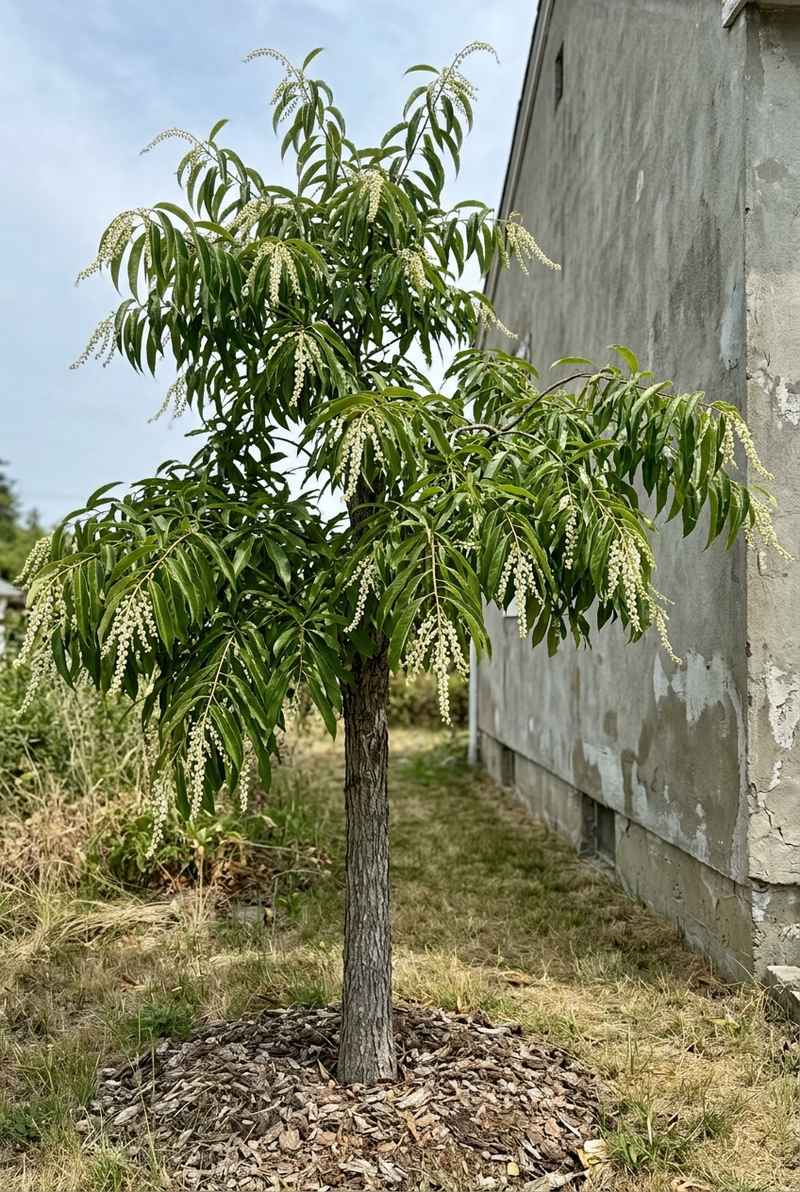
Taller than the others, but just as slim.
Sourwood reaches 20 to 30 feet (6 to 9 m) and stays 10 to 15 feet (3 to 4.5 m) wide. It’s a native of the eastern United States, tolerant of shade and dry soil.
Two cautions. It’s intolerant of pollution and urban conditions, so skip it on a busy street, and it hates being transplanted. Buy it young and plant it once.
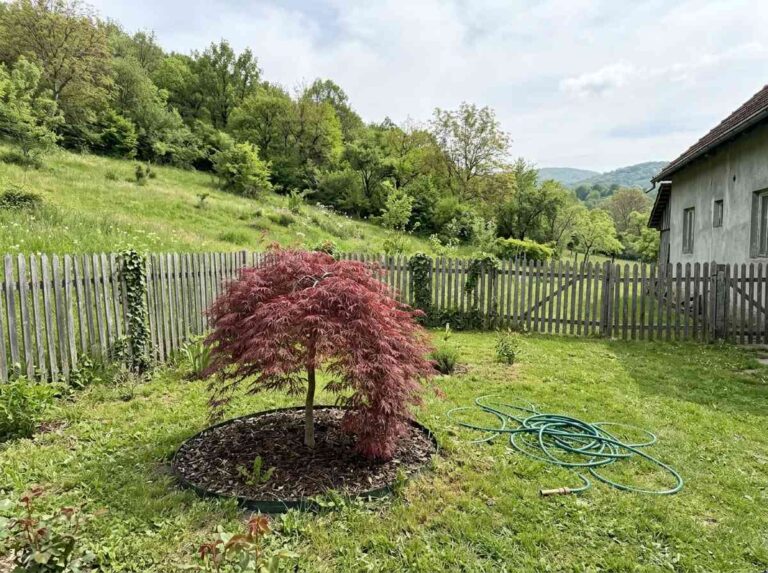
Save this to Pinterest7. Bloodgood Japanese Maple
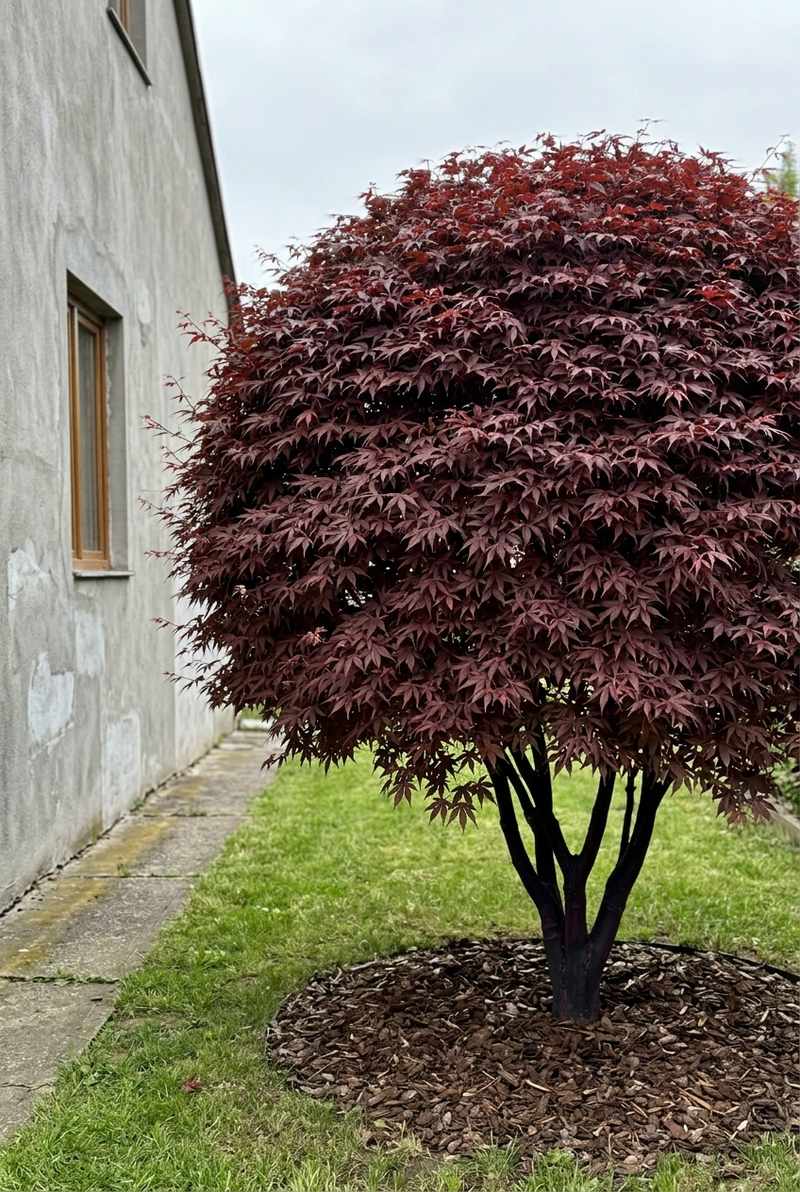
The classic front-of-house tree, and the classic one to plant too close.
‘Bloodgood’ can grow up to 20 feet (6 m) tall and wide, so the cute thing in the nursery pot needs at least 6 to 10 feet (1.8 to 3 m) from the wall. Growth is slow to moderate, with a round, dense crown.
It wants well-drained soil and good air circulation, and the leaves can scorch in hot, dry summers.
8. Witch Hazel
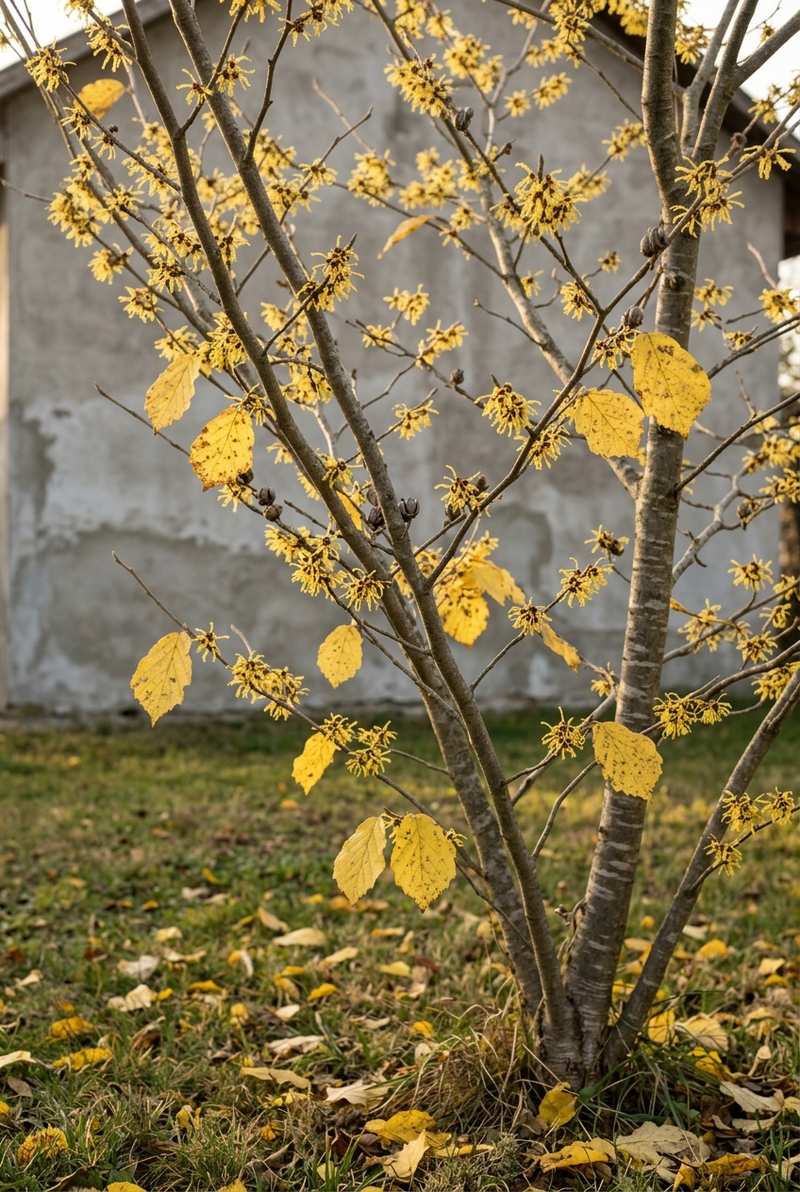
It blooms when the rest of the front yard has shut down: yellow, spidery flowers from October to December.
This native grows 15 to 30 feet (4.5 to 9 m) tall and 15 to 20 feet (4.5 to 6 m) wide. NC State notes it can carry flowers and fruit at the same time, which is unusual, and that pruning isn’t usually necessary.
It has no serious pests. For the best flowering, give it full sun.
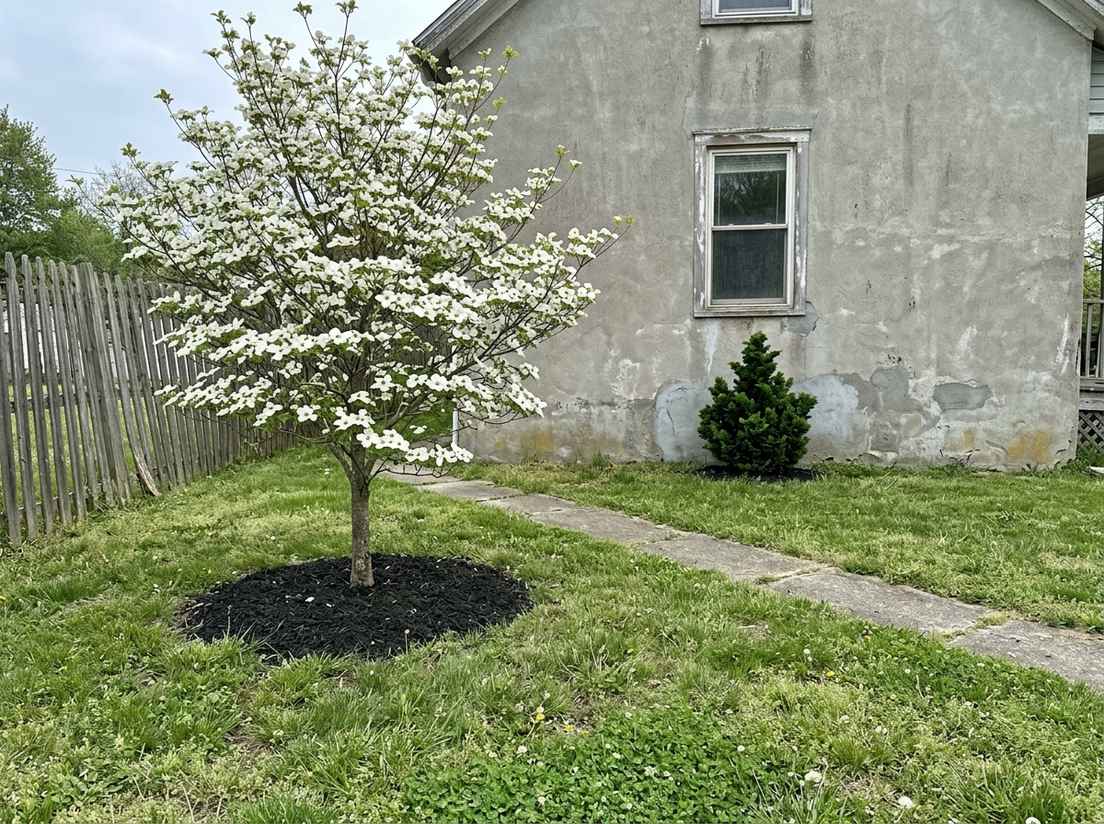
9. Flowering Dogwood
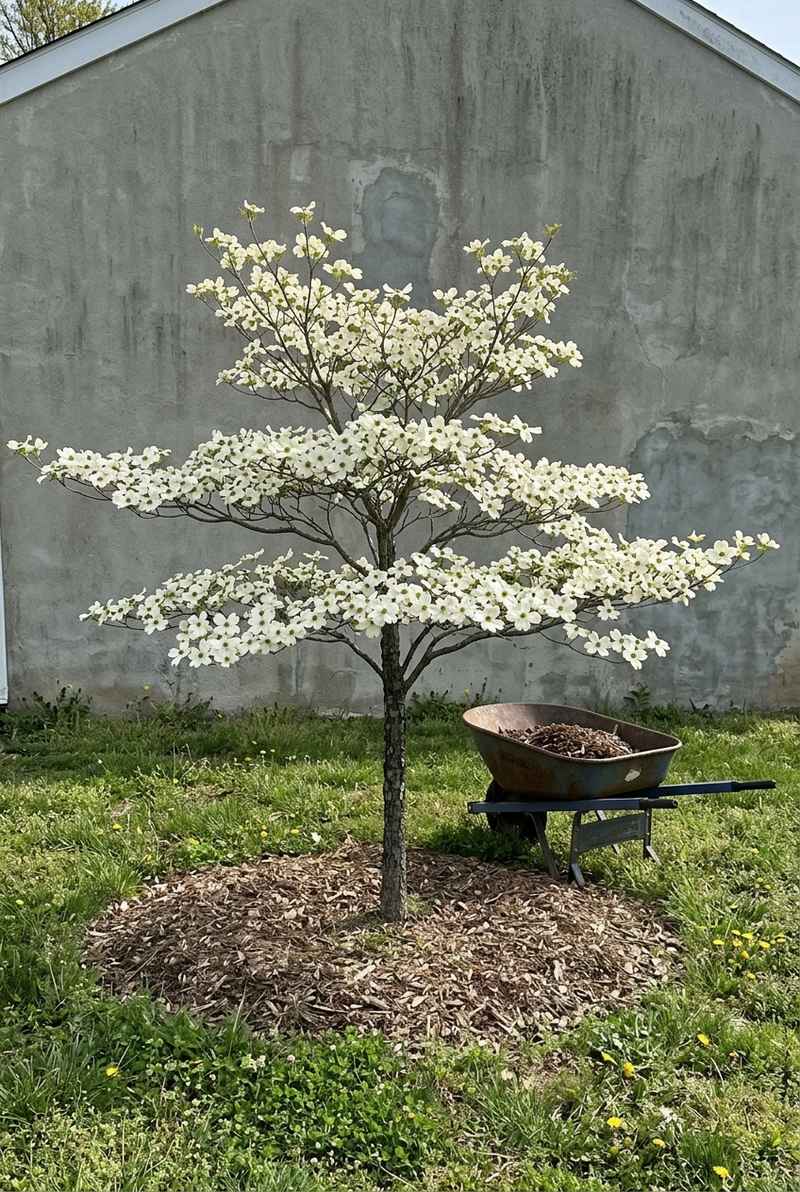
Everyone’s favorite, and honestly a little fussy (I say that with love).
NC State calls it tricky to grow in a landscape setting. In hot regions it wants afternoon shade, and a 2 to 4 inch (5 to 10 cm) layer of mulch helps keep the roots cool and moist.
Mature trees spread 15 to 30 feet (4.5 to 9 m). So despite the delicate look, this one belongs well out from the wall, on the east or north side if summers are hot.
10. American Smoketree
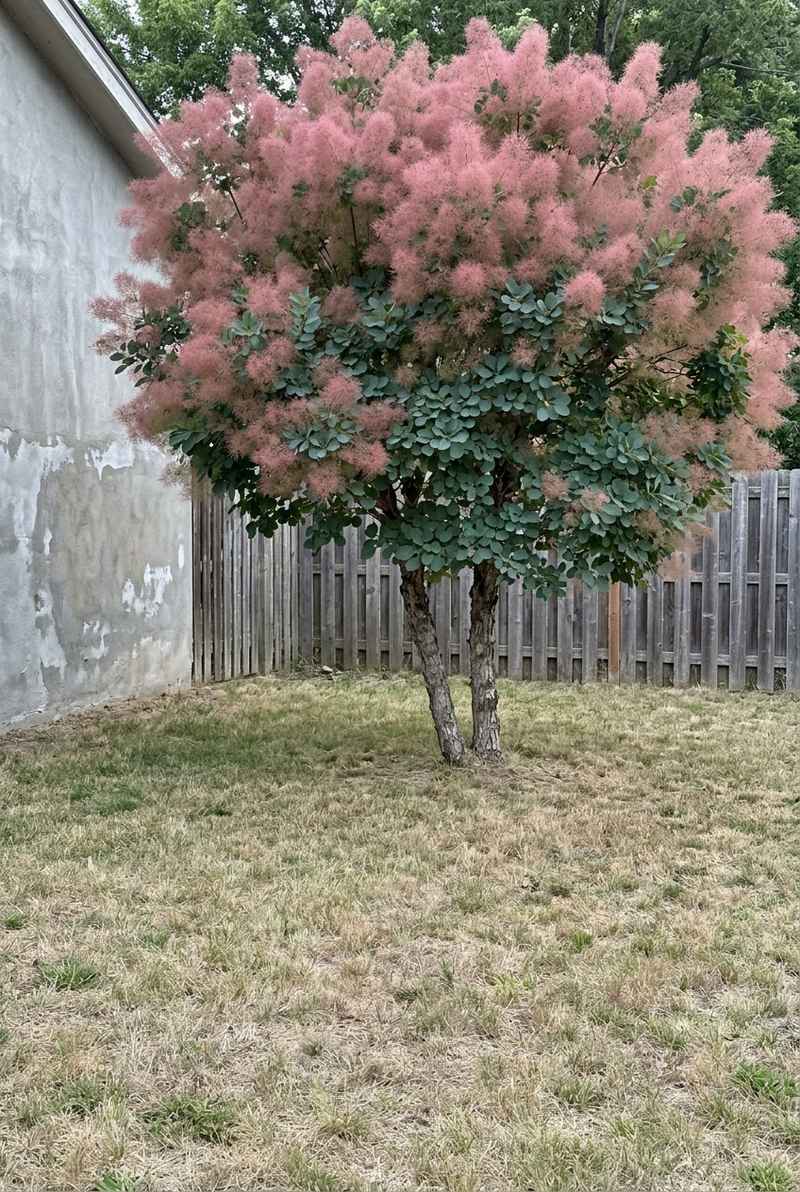
The biggest tree on the list, for the far corner of the front yard.
It’s a native with airy, smoky pink plumes after flowering that make the whole tree look like it’s wrapped in haze. It tolerates clay and shallow rocky soil, and it prefers soil that isn’t rich.
At 20 to 30 feet (6 to 9 m) tall and wide, keep it 10 to 15 feet (3 to 4.5 m) from the house at the very least. Avoid low spots that stay wet.
Trees to Keep Far From the House
Small trees are forgiving. These three aren’t, and all of them get planted near houses constantly.
| Tree | What NC State Extension says |
|---|---|
| Silver maple | Shallow roots disturb driveways and sidewalks and invade septic systems and drains. The wood is weak and breaks in storms |
| Weeping willow | Invasive roots can damage water or sewage pipes |
| Eastern cottonwood | Roots may damage sidewalks or sewer lines, and the wood is brittle |
Questions About Planting Trees Near a House
Which small trees have non-invasive roots?
No tree comes with a guarantee, but small trees are the safer bet. One arborist on the UBC Botanical Garden forum summed up years of site visits by saying that, as a general rule, small trees come with small root problems.
How close to the house can I plant a small tree?
No closer than half its mature spread, and more if you can. For a star magnolia that means 5 to 7.5 feet (1.5 to 2.5 m), and for a Bloodgood Japanese maple 6 to 10 feet (1.8 to 3 m).
Can tree roots crack a foundation?
According to Purdue’s extension, roots that meet a solid foundation are redirected, and they mostly exploit cracks that already exist. The damage stories usually involve big trees growing right up against the house.
Will roots get into my pipes?
Roots move into pipes that already leak, because that’s where the water is. That’s one more reason to keep willows, silver maples and cottonwoods far from sewer and septic lines.
Measure Twice, Plant Once
The scraping maple is gone now. In its place, a good eight feet (2.5 m) further out, there’s a star magnolia about the height of my knee.
Pick the tree by its mature spread. Then measure from the wall before you dig.
If the front bed needs more than one tree, my lists of small flowering trees for the front yard and front-of-house shrubs for full sun fill in the rest. And if roots still worry you, Purdue’s explanation is the clearest I’ve read.