How to Prune a Weeping Cherry Tree (Without Ruining the Shape)

- Grafted trees
- Straight shoots explained
- When to prune
- Fixing a bad cut
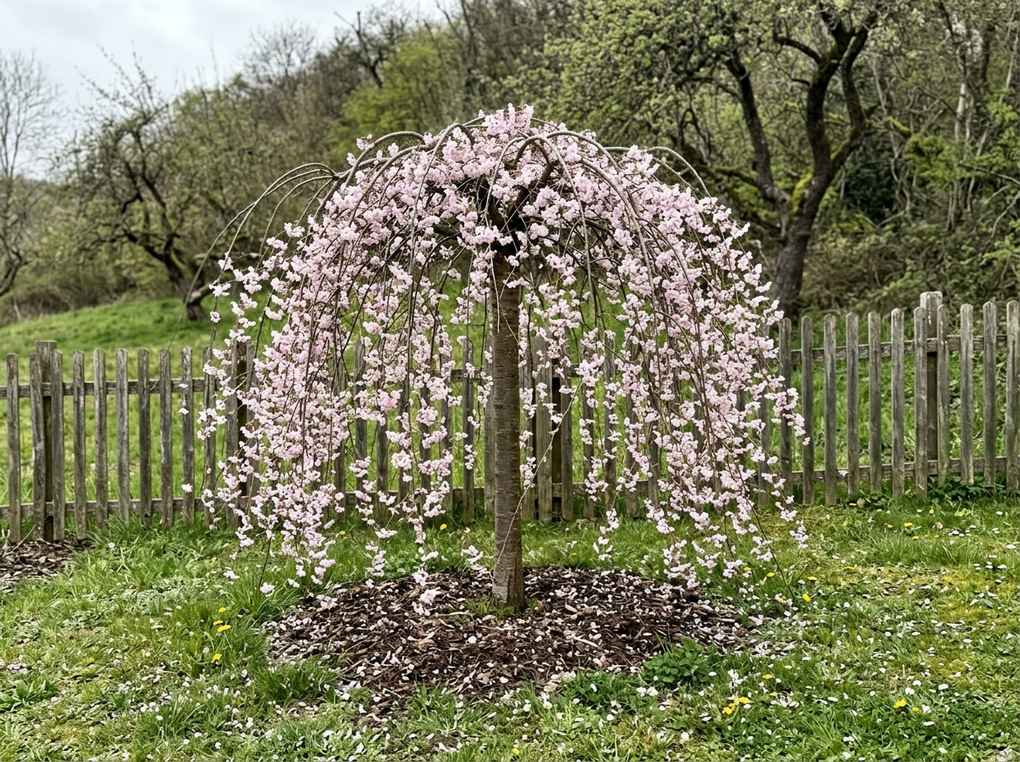
Two streets over, a weeping cherry gets a haircut every spring. A neat bowl cut, all the way around, level with the mailbox.
And every summer it answers with a tuft of straight green sticks out of the top, like a startled cartoon character.
I walked past that tree for a year before I understood what was going on. The owner wasn’t pruning too little. They were pruning too much, in exactly the wrong way.
A weeping cherry needs less cutting than almost any tree in the yard, as long as you know which few cuts matter.
At a Glance
- Most weeping cherries are grafted: a weeping top joined to a straight trunk
- Any shoot from below the graft is rootstock. Cut it off flush, any time of year
- Don’t shorten the hanging branches into an umbrella. They grow back stiff and upright
- Each year, remove only dead, damaged, crossing and overcrowded branches
- Do your pruning shortly after the flowers finish.
Find the Graft Before You Find the Pruners
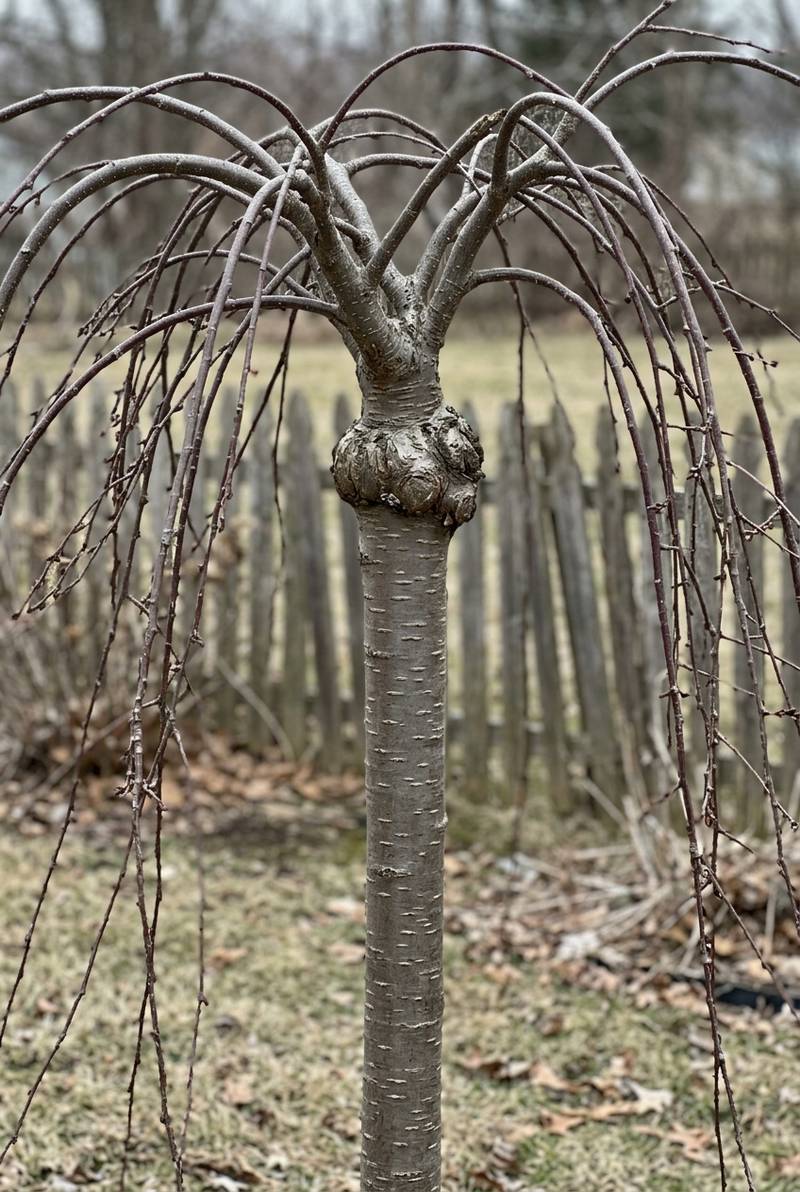
Everything else depends on this, so start here.
Most weeping cherries at a garden center are really two trees joined together. A weeping variety sits on top of the straight trunk of a different cherry, and that join is what puts the fountain at head height.
Look along the trunk for a slight bulge, or a place where the bark’s texture shifts. The National Gardening Association says it usually sits between waist height and head height, and Missouri Botanical Garden puts the common top graft at about 5 to 6 feet (1.5 to 1.8 m).
Above that line is the tree you bought. Below it is a different tree entirely, and it doesn’t weep.
(If you can’t find a graft, you may have a naturally weeping type such as Snow Fountains. Lucky you. The rest of this still applies.)
Straight Shoots: Two Kinds, Two Answers
Sooner or later a weeping cherry sends up something that points at the sky. Where it comes from decides what you do.
| Where the straight shoot starts | What it is | What to do |
|---|---|---|
| Below the graft, or from the base | Rootstock. It will never weep | Remove it right at its base, the day you spot it |
| Inside the weeping canopy, already stiff | A branch that hardened upright | Cut it out. It won’t come back down |
| Inside the canopy, still young and bendy | A branch you can still train | Weight it gently so it sets pointing down |
The first kind is the dangerous one. Rootstock shoots are far more vigorous than the weeping top, and left alone they crowd it out until you own a plain upright cherry. Missouri Botanical Garden says these non-weeping suckers should be promptly removed.
Don’t wait for pruning season. This is the one cut you make the day you notice it.
How to Spot Rootstock Growth
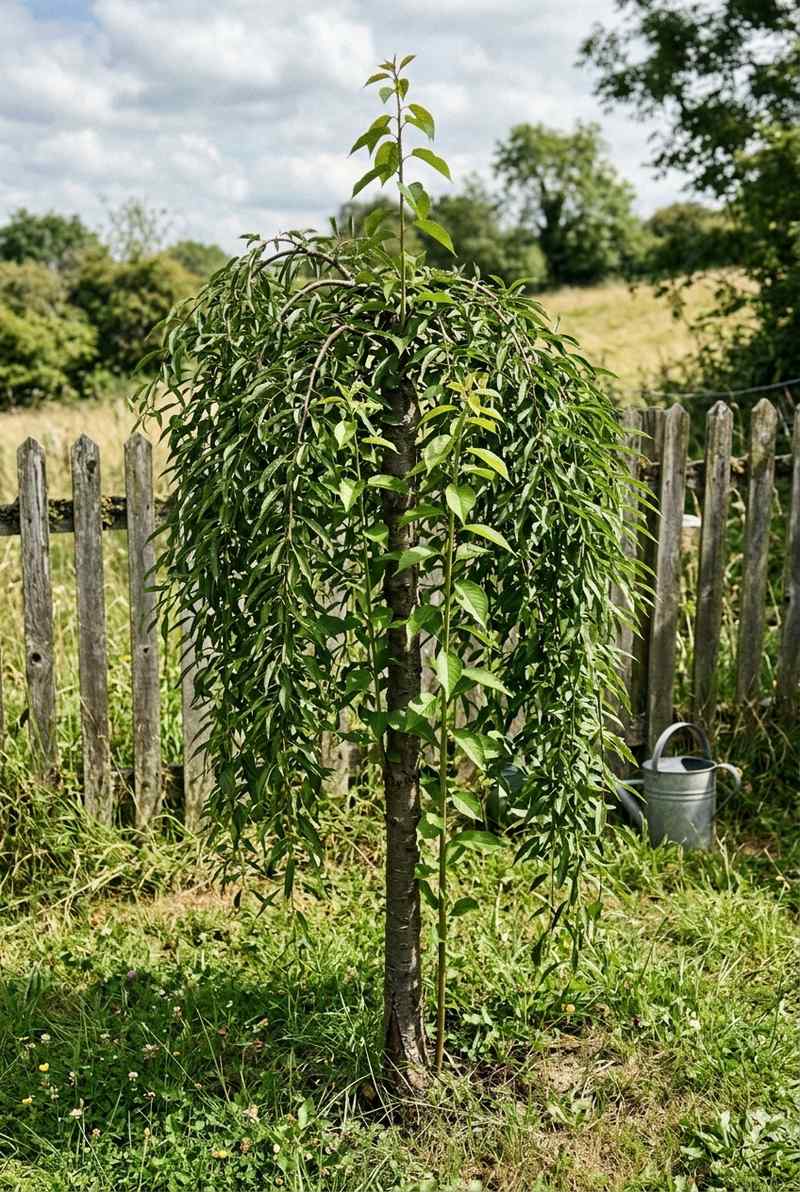
It usually gives itself away.
New Hampshire Extension notes that suckers from below a graft union tend to look completely different from the variety on top. On a weeping cherry that means a shoot heading straight up, growing fast, often with leaves that don’t quite match.
They aren’t harmless while you decide what to do. As the University of Connecticut’s garden educators put it, these shoots use water, nutrients and energy that the rest of the tree could have had.
So follow the shoot down to where it starts and cut it flush there. No stub, no “I’ll get it next month.”
Training a young shoot down
For a flexible shoot inside the canopy, the National Gardening Association suggests hanging a small, soft weight on it for about a year, until the branch stiffens in its new position. Never tie anything tightly around the wood, because a tight loop strangles the branch as it thickens.
What This Tree Needs Each Year
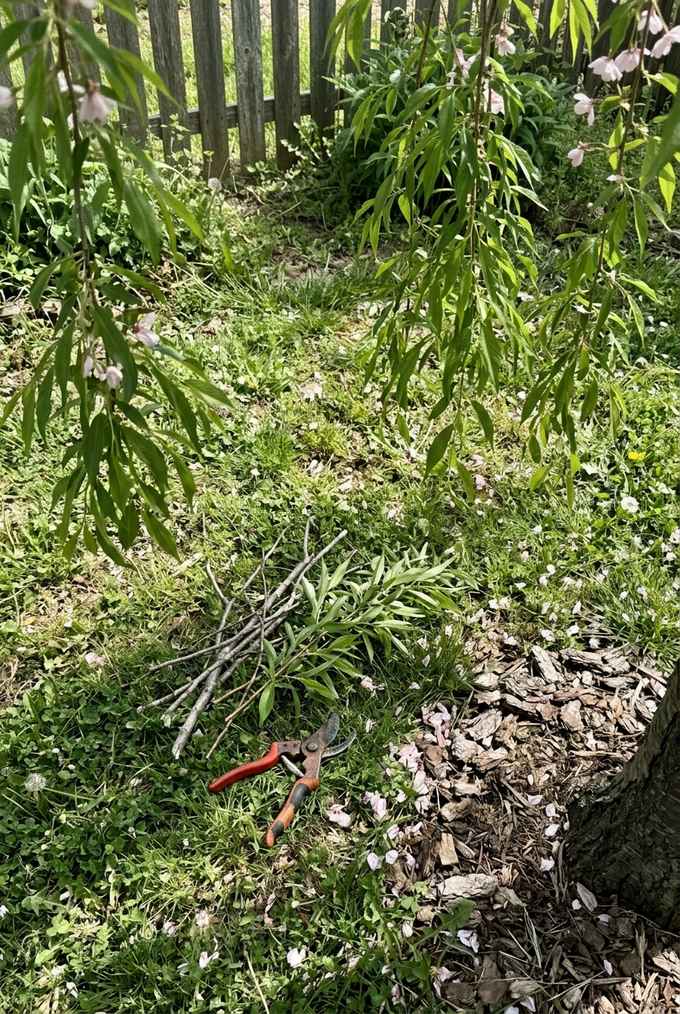
Hardly any. That surprised me too.
Missouri Botanical Garden’s notes on weeping cherry say it generally requires little pruning, and the National Gardening Association’s yearly list is short:
Dead and damaged wood comes out first.
Then any branches that cross and rub against each other.
Then the spots where the branches have matted into a thick tangle get thinned. Take whole branches back to where they start, not half-branches.
Last, anything dragging on the ground can be shortened just enough to mow under.
That’s it. If you end up holding more than a small armful of cuttings, you’ve overdone it.
Save this to PinterestThe Cut That Ruins the Shape
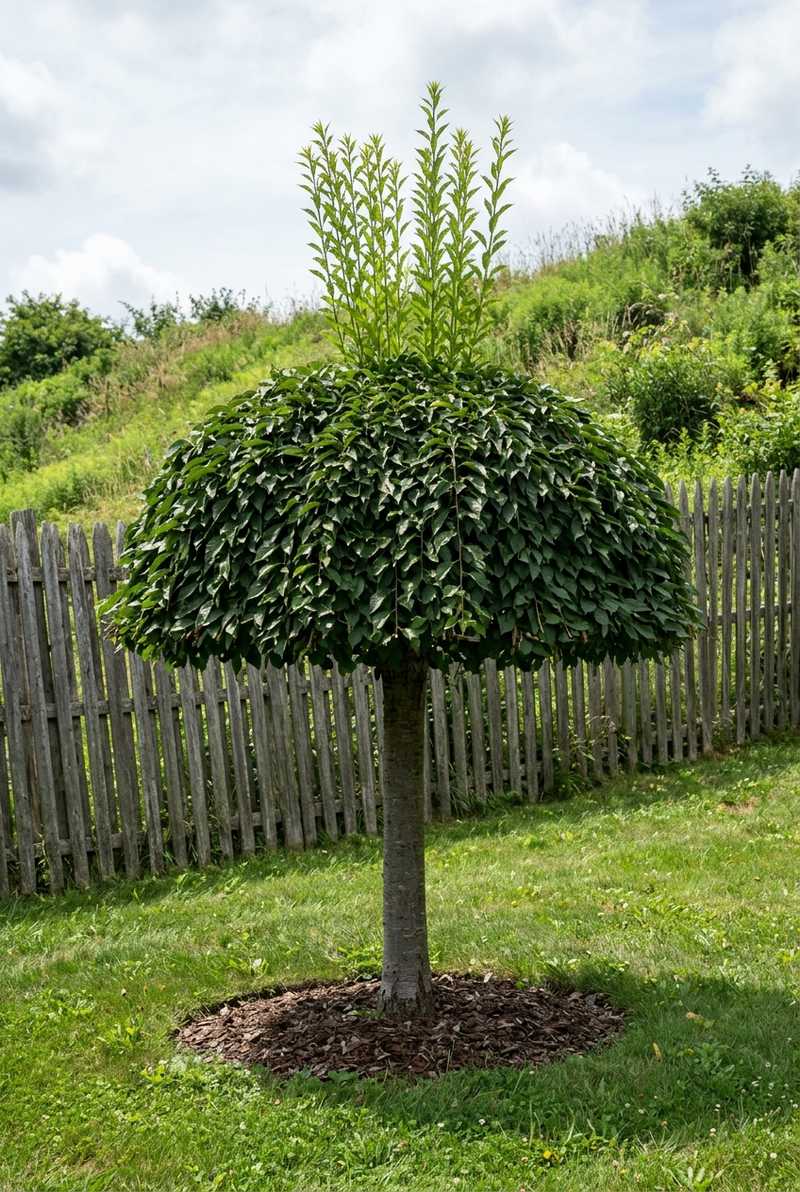
Now back to the bowl cut down the street.
It feels logical. The branches are too long, so you shorten them all to the same length. But a weeping branch that’s cut back tends to regrow stiffer and more upright, which is the opposite of what you wanted.
And it gets worse with every round. A hard cut makes the tree answer with a flush of straight, vigorous shoots, so next year there’s more to cut, and the year after that even more.
The University of New Hampshire Extension explains why: trees respond to stress with upright shoots called water sprouts, and it lists topping and over-pruning among the causes. Round and round it goes.
The umbrella haircut
Shearing a weeping cherry into an even dome removes the long, hanging branch ends that make it weep, and it pushes the tree into growing straight shoots instead. If a branch is too long, remove that whole branch at its origin or leave it alone.
Timing It
Prune shortly after the flowers finish in spring.
There are two reasons. The flower buds for next year form during the summer, so cutting later in the year removes them. And a cut made right after bloom has months of growing weather ahead to heal over.
The exception is rootstock shoots. Those go the moment you see them, in any month.
If It’s Already Been Butchered
Maybe you inherited the bowl cut. Maybe (no judgment) you gave it.
It’s fixable, but not in one afternoon. New Hampshire Extension warns that removing too many sprouts in one go just brings them back.
So spread the repair over a couple of years. Each spring after bloom, take out the worst of the stiff upright shoots, whole, at their base. Leave the tree most of its leaves so it isn’t stressed into sprouting again.
Meanwhile, catch the new shoots while they’re soft and weight them downward. Those become your new curtain.
For large limbs, anything that needs a ladder, or anything near a wire, call a certified arborist. Cherries are prone to cankers and borers, and a big clean cut made by a professional is worth the money.
Questions About Pruning Weeping Cherries
Can I cut the branches that touch the ground?
Yes. Shorten them just enough to walk or mow underneath. Keep the cut ends at different lengths, so the tree still looks like a fountain and not a lampshade.
Why is my weeping cherry growing straight up?
Two possibilities. Shoots from below the graft are rootstock and need to come off at once. Shoots from inside the canopy are usually a reaction to heavy pruning, and those you thin out gradually.
How big will a weeping cherry get?
It depends on the type. A top-grafted tree gets its height from the trunk it was grafted on, usually 5 to 6 feet (1.5 to 1.8 m), plus the dome above. An ungrafted weeping Higan cherry is a real tree: NC State lists it at 15 to 40 feet (4.5 to 12 m).
Does a weeping cherry need pruning every year?
Not much. A quick check each spring for rootstock shoots, dead wood and crossing branches is enough, and some years you won’t cut anything at all.
Can I keep it small by pruning hard?
Not without wrecking the shape. If the tree is too big for its spot, a smaller variety is the answer, and I listed several in my dwarf weeping trees guide.
Less Cutting, More Weeping
When I finally plant a weeping cherry of my own, this is the whole plan: graft check, a few small cuts, done before the coffee gets cold.
Rootstock off, dead wood out, and hands off the hanging ends. The same “less is more” rule runs through my guide to pruning hydrangeas, and if you’re still choosing a tree, my small flowering trees list has a few that never need this conversation. For the science of why trees sprout after hard pruning, New Hampshire Extension explains it well, and Missouri Botanical Garden has the profile of the classic weeping cherry.